

Ch. 19 - Amines
Wade - Organic Chemistry 9th Edition
Wade9th EditionOrganic ChemistryISBN: 9780135213728Non è quello che usi tu?Cambia libro di testo
Capitolo 19, Problema 50g

Show how you can synthesize the following compounds starting with benzene, toluene, and alcohols containing no more than four carbon atoms as your organic starting materials. Assume that para is the major product (and separable from ortho) in ortho, para mixtures.
(g) 4-isobutylaniline

Guida verificata passo dopo passo
1
Step 1: Start with toluene as the base compound. Perform a Friedel-Crafts alkylation using isobutyl chloride (CH3CH(CH3)CH2Cl) and AlCl3 as the catalyst to introduce the isobutyl group at the para position relative to the methyl group. This step gives para-isobutyltoluene as the major product.
Step 2: Oxidize the methyl group on the benzene ring of para-isobutyltoluene to a carboxylic acid group. This can be achieved using a strong oxidizing agent such as potassium permanganate (KMnO4) under acidic or basic conditions. The product is para-isobutylbenzoic acid.
Step 3: Convert the carboxylic acid group to an amine group (-NH2) through a two-step process. First, reduce the carboxylic acid to a primary amide (-CONH2) using reagents like SOCl2 followed by NH3. Then, reduce the amide to an amine using a reducing agent such as lithium aluminum hydride (LiAlH4). This step yields 4-isobutylaniline.
Step 4: Purify the product to isolate 4-isobutylaniline. Since para is the major product, it can be separated from any minor ortho product using techniques like recrystallization or column chromatography.
Step 5: Verify the structure of the synthesized compound using spectroscopic techniques such as NMR (nuclear magnetic resonance) and IR (infrared spectroscopy) to confirm the presence of the isobutyl group and the amine group at the para position.

Risposta video verificata per un problema simile:

Questa soluzione video è stata consigliata dai nostri tutor come utile per risolvere questo problema.
Durata del video:
4m

Concetti chiave

Ecco i concetti essenziali che devi comprendere per rispondere correttamente alla domanda.

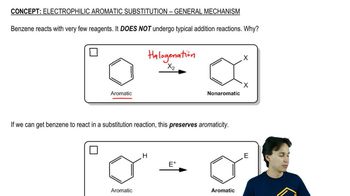
Electrophilic Aromatic Substitution (EAS)

Electrophilic Aromatic Substitution is a fundamental reaction in organic chemistry where an electrophile replaces a hydrogen atom on an aromatic ring. This reaction is crucial for synthesizing substituted aromatic compounds, such as 4-isobutylaniline, from benzene or toluene. Understanding the mechanism of EAS, including the role of activating and deactivating groups, is essential for predicting the outcome of the synthesis.
Video consigliato:
03:07
EAS Review

Nucleophilic Aromatic Substitution (NAS)

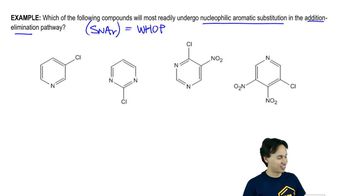
Nucleophilic Aromatic Substitution is a reaction where a nucleophile replaces a leaving group on an aromatic compound. This concept is particularly relevant when synthesizing compounds like 4-isobutylaniline, as it may involve the introduction of an amine group onto a substituted aromatic ring. Recognizing the conditions under which NAS occurs, such as the presence of electron-withdrawing groups, is vital for successful synthesis.
Video consigliato:
02:10
NAS in the addition-elimination pathway

Functional Group Interconversion

Functional Group Interconversion refers to the transformation of one functional group into another, which is often necessary in organic synthesis. In the context of synthesizing 4-isobutylaniline, converting alcohols or alkyl groups into amines or other functional groups is essential. Mastery of various reactions, such as reduction or substitution, allows chemists to manipulate starting materials effectively to achieve desired products.
Video consigliato:
02:36
Identifying Functional Groups
Pratica correlata
Domanda del libro di testo

Show how you can synthesize the following compounds starting with benzene, toluene, and alcohols containing no more than four carbon atoms as your organic starting materials. Assume that para is the major product (and separable from ortho) in ortho, para mixtures.

(d) N-benzylpropan-1-amine

619
views
Domanda del libro di testo

Show how you can synthesize the following compounds starting with benzene, toluene, and alcohols containing no more than four carbon atoms as your organic starting materials. Assume that para is the major product (and separable from ortho) in ortho, para mixtures.

(b) N-methylbutan-1-amine

401
views
Domanda del libro di testo

Show how you can synthesize the following compounds starting with benzene, toluene, and alcohols containing no more than four carbon atoms as your organic starting materials. Assume that para is the major product (and separable from ortho) in ortho, para mixtures.

(c) N-ethyl-N-propylbutan-2-amine

638
views
Domanda del libro di testo

Using any necessary reagents, show how you can accomplish the following multistep syntheses.

(b)

913
views
Domanda del libro di testo

Using any necessary reagents, show how you can accomplish the following multistep syntheses.

(c)

972
views
Domanda del libro di testo

Pyrrole undergoes electrophilic aromatic substitution more readily than benzene, and mild reagents and conditions are sufficient. These reactions normally occur at the 2-position rather than the 3-position, as shown in the following example.

a. Propose a mechanism for the acetylation of pyrrole just shown. You may begin with pyrrole and the acylium ion, CH3C≡O+. Be careful to draw all the resonance structures of the intermediate.

4010
views