Ch. 19 - Amines
Wade - Organic Chemistry 9th Edition
Wade9th EditionOrganic ChemistryISBN: 9780135213728Non è quello che usi tu?Cambia libro di testo
Capitolo 19, Problema 30b

Show how you would accomplish the following synthetic conversions.
(b) 1-bromo-2-phenylethane → 3-phenylpropan-1-amine

Guida verificata passo dopo passo
1
Step 1: Recognize that the starting material, 1-bromo-2-phenylethane, contains a bromine atom that can act as a leaving group. The target molecule, 3-phenylpropan-1-amine, contains an amine group (-NH2) at the terminal position. This suggests a nucleophilic substitution reaction followed by chain elongation.
Step 2: Perform a nucleophilic substitution reaction using cyanide ion (CN⁻) as the nucleophile. Treat 1-bromo-2-phenylethane with potassium cyanide (KCN) in an appropriate solvent like DMSO. This will replace the bromine atom with a nitrile group (-C≡N), forming 2-phenylacetonitrile.
Step 3: Reduce the nitrile group (-C≡N) in 2-phenylacetonitrile to a primary amine (-CH2-NH2). Use a reducing agent such as lithium aluminum hydride (LiAlH4) in anhydrous ether to achieve this transformation, yielding 3-phenylpropan-1-amine.
Step 4: Ensure proper workup after each reaction step. For the reduction step, carefully quench the reaction with water or dilute acid to neutralize excess LiAlH4 and isolate the amine product.
Step 5: Purify the final product, 3-phenylpropan-1-amine, using techniques such as distillation or recrystallization, depending on the physical properties of the compound.

Risposta video verificata per un problema simile:

Questa soluzione video è stata consigliata dai nostri tutor come utile per risolvere questo problema.
Durata del video:
3m

Concetti chiave

Ecco i concetti essenziali che devi comprendere per rispondere correttamente alla domanda.

Nucleophilic Substitution

Nucleophilic substitution is a fundamental reaction in organic chemistry where a nucleophile replaces a leaving group in a molecule. In this case, the bromine atom in 1-bromo-2-phenylethane acts as a leaving group, allowing the nucleophile (an amine) to attach to the carbon atom. Understanding the mechanisms of nucleophilic substitution, such as SN1 and SN2, is crucial for predicting the outcome of the reaction.
Video consigliato:
01:47
Nucleophiles and Electrophiles can react in Substitution Reactions.

Amine Synthesis

Amine synthesis involves the formation of amines, which are organic compounds derived from ammonia by replacing one or more hydrogen atoms with alkyl or aryl groups. In the conversion from 1-bromo-2-phenylethane to 3-phenylpropan-1-amine, the introduction of an amine group is essential. Familiarity with various methods of amine synthesis, including reductive amination and nucleophilic substitution, is important for successful conversions.
Video consigliato:
07:12
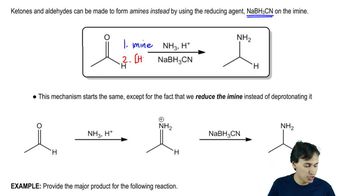
Reductive Amination

Rearrangement Reactions

Rearrangement reactions involve the structural reorganization of a molecule, often leading to the formation of more stable or reactive products. In this conversion, the initial carbon skeleton of 1-bromo-2-phenylethane must be rearranged to form 3-phenylpropan-1-amine. Understanding how and why certain rearrangements occur, including the stability of intermediates, is key to predicting the products of synthetic pathways.
Video consigliato:
06:28
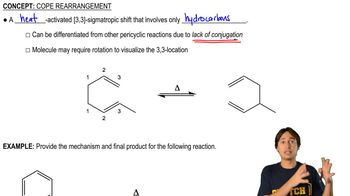
Definition of Cope Rearrangement