Ch. 19 - Amines
Wade - Organic Chemistry 9th Edition
Wade9th EditionOrganic ChemistryISBN: 9780135213728Non è quello che usi tu?Cambia libro di testo
Capitolo 19, Problema 45a

Synthesize from benzene. (Hint: All of these require diazonium ions.)
(a) 3-ethylbenzoic acid

Guida verificata passo dopo passo
1
Step 1: Start with benzene as the base compound. Perform a Friedel-Crafts alkylation using ethyl chloride (CH₃CH₂Cl) and aluminum chloride (AlCl₃) as a catalyst to introduce an ethyl group onto the benzene ring, forming ethylbenzene.
Step 2: Nitrate the ethylbenzene by reacting it with a mixture of concentrated nitric acid (HNO₃) and sulfuric acid (H₂SO₄). This introduces a nitro group (-NO₂) onto the benzene ring, forming nitroethylbenzene. The nitro group will preferentially go to the meta position relative to the ethyl group due to the electron-donating nature of the ethyl group.
Step 3: Reduce the nitro group (-NO₂) to an amino group (-NH₂) by using a reducing agent such as tin (Sn) and hydrochloric acid (HCl), forming meta-ethylaminobenzene.
Step 4: Convert the amino group (-NH₂) into a diazonium ion (-N₂⁺) by treating the compound with sodium nitrite (NaNO₂) and hydrochloric acid (HCl) at 0–5°C. This forms meta-ethylbenzenediazonium chloride.
Step 5: Replace the diazonium group (-N₂⁺) with a carboxylic acid group (-COOH) by performing a Sandmeyer reaction using copper(I) cyanide (CuCN), followed by hydrolysis of the resulting nitrile group (-CN) with aqueous acid or base. This yields 3-ethylbenzoic acid.

Risposta video verificata per un problema simile:

Questa soluzione video è stata consigliata dai nostri tutor come utile per risolvere questo problema.
Durata del video:
9m

Concetti chiave

Ecco i concetti essenziali che devi comprendere per rispondere correttamente alla domanda.

Benzene and its Derivatives

Benzene is a fundamental aromatic hydrocarbon characterized by its stable ring structure and delocalized π-electrons. Understanding benzene's reactivity is crucial, as it undergoes electrophilic substitution reactions rather than addition, allowing for the introduction of various substituents, such as carboxylic acids or alkyl groups, onto the ring.
Video consigliato:
02:49
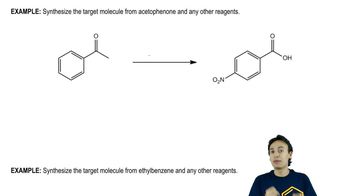
Aromatic synthesis starting with benzene/benzene derivatives

Diazonium Ions

Diazonium ions are highly reactive intermediates formed from primary aromatic amines and nitrous acid. They play a pivotal role in organic synthesis, particularly in the formation of substituted aromatic compounds through reactions like Sandmeyer or azo coupling, which are essential for synthesizing compounds like 3-ethylbenzoic acid from benzene.
Video consigliato:
Percorso guidato
3:39
Metal Ion Catalysis Concept 1

Electrophilic Substitution Reactions

Electrophilic substitution reactions are a class of reactions where an electrophile replaces a hydrogen atom on an aromatic ring. This mechanism is vital for modifying aromatic compounds, allowing for the introduction of functional groups, such as carboxylic acids, which is necessary for synthesizing 3-ethylbenzoic acid from benzene using diazonium ions.
Video consigliato:
01:47
Nucleophiles and Electrophiles can react in Substitution Reactions.