Ch. 19 - Amines
Wade - Organic Chemistry 9th Edition
Wade9th EditionOrganic ChemistryISBN: 9780135213728Non è quello che usi tu?Cambia libro di testo
Capitolo 19, Problema 34a,b

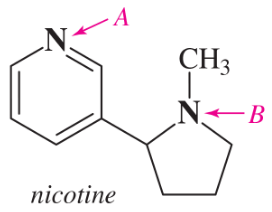
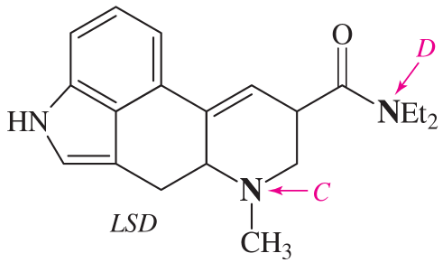
Within each structure, rank the indicated nitrogens by increasing basicity.
(a)
(b)

Guida verificata passo dopo passo
1
Step 1: Understand the concept of basicity in nitrogen atoms. Basicity is determined by the ability of a nitrogen atom to donate its lone pair of electrons. Factors such as resonance, inductive effects, hybridization, and steric hindrance influence basicity.
Step 2: Analyze structure (i). Nitrogen A is part of a pyridine ring, where the lone pair is delocalized due to resonance with the aromatic ring, reducing its basicity. Nitrogen B is part of a saturated amine group, where the lone pair is localized and not involved in resonance, making it more basic than Nitrogen A.
Step 3: Analyze structure (ii). Nitrogen C is part of an aromatic system, where its lone pair is delocalized due to resonance, reducing its basicity. Nitrogen D is part of a dimethylamino group, where the lone pair is localized and not involved in resonance, making it more basic than Nitrogen C.
Step 4: Consider the influence of substituents and hybridization. In structure (i), Nitrogen A is sp2 hybridized and part of an aromatic system, while Nitrogen B is sp3 hybridized and part of a saturated amine group. In structure (ii), Nitrogen C is sp2 hybridized and part of an aromatic system, while Nitrogen D is sp3 hybridized and part of a dimethylamino group.
Step 5: Rank the nitrogens in each structure by increasing basicity. For structure (i), rank Nitrogen A < Nitrogen B. For structure (ii), rank Nitrogen C < Nitrogen D.

Risposta video verificata per un problema simile:

Questa soluzione video è stata consigliata dai nostri tutor come utile per risolvere questo problema.
Durata del video:
3m

Concetti chiave

Ecco i concetti essenziali che devi comprendere per rispondere correttamente alla domanda.

Basicity of Amines

Basicity in organic chemistry refers to the ability of a compound to accept protons (H+ ions). Amines, which contain nitrogen atoms with lone pairs, can act as bases. The basicity of an amine is influenced by the availability of the lone pair for protonation, which can be affected by steric hindrance and electronic effects from surrounding groups.
Video consigliato:
07:12
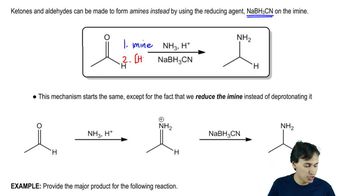
Reductive Amination

Resonance Effects

Resonance effects occur when electrons are delocalized across multiple atoms, stabilizing the molecule. In the context of amines, resonance can either enhance or reduce basicity. For example, if the nitrogen's lone pair is involved in resonance with an adjacent aromatic system, it becomes less available for protonation, decreasing basicity.
Video consigliato:
03:32
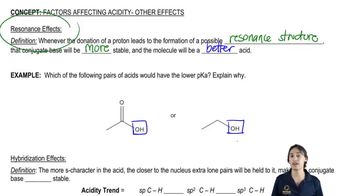
Understanding Resonance Effects

Inductive Effects

Inductive effects refer to the electron-withdrawing or electron-donating influence of substituents on a molecule. Electron-withdrawing groups (EWGs) decrease basicity by stabilizing the positive charge that forms upon protonation, while electron-donating groups (EDGs) increase basicity by making the lone pair on nitrogen more available. Understanding these effects is crucial for ranking the basicity of the nitrogens in the given structures.
Video consigliato:
01:47
Understanding the Inductive Effect.