Ch. 20 - Carboxylic Acids
Wade - Organic Chemistry 9th Edition
Wade9th EditionOrganic ChemistryISBN: 9780135213728Non è quello che usi tu?Cambia libro di testo
Capitolo 20, Problema 17a

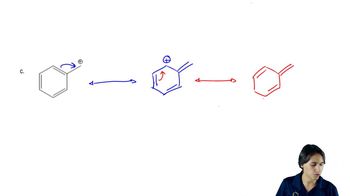
The given was missing some important resonance forms of the intermediates shown in brackets. Complete this mechanism by drawing all the resonance forms of these intermediates. Do your resonance forms help to explain why this reaction occurs under very mild conditions (water with a tiny trace of acid)?

Guida verificata passo dopo passo
1
Identify the intermediates in the given reaction mechanism. These are typically carbocations, carbanions, or radicals that can have resonance structures.
Draw the Lewis structure for each intermediate, ensuring that all atoms have the correct number of valence electrons and that the overall charge is correct.
Determine possible resonance structures by moving electrons. Look for pi bonds, lone pairs, or charges that can be delocalized to adjacent atoms. Remember that only electrons move, not atoms.
Draw each resonance structure, ensuring that all resonance forms obey the rules of resonance: the same number of unpaired electrons, the same number of total electrons, and valid Lewis structures.
Analyze the resonance structures to determine their stability. More stable resonance forms contribute more to the resonance hybrid, which can help explain why the reaction occurs under mild conditions. Consider factors like charge distribution and the octet rule.

Risposta video verificata per un problema simile:

Questa soluzione video è stata consigliata dai nostri tutor come utile per risolvere questo problema.
Durata del video:
4m

Concetti chiave

Ecco i concetti essenziali che devi comprendere per rispondere correttamente alla domanda.

Resonance Structures

Resonance structures are different Lewis structures for a molecule that depict the same arrangement of atoms but differ in the distribution of electrons. They are used to represent delocalized electrons within certain molecules or polyatomic ions where the bonding cannot be expressed by a single Lewis structure. Understanding resonance is crucial for predicting the stability and reactivity of intermediates in a reaction.
Video consigliato:
03:04
Drawing Resonance Structures

Reaction Mechanism

A reaction mechanism is a step-by-step sequence of elementary reactions by which an overall chemical change occurs. It details the breaking and forming of bonds, the intermediates formed, and the transition states. Understanding the mechanism helps in identifying the role of intermediates and the conditions under which a reaction proceeds, such as the mild conditions mentioned in the problem.
Video consigliato:
02:16
Heck Reaction Mechanism

Acid-Catalyzed Reactions

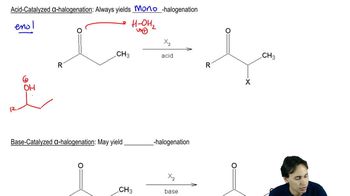
Acid-catalyzed reactions involve the use of an acid to increase the rate of a chemical reaction. The acid donates a proton (H+) to a reactant, making it more electrophilic and thus more reactive. In the context of the problem, the presence of a trace of acid in water can facilitate the reaction by stabilizing intermediates through protonation, which is often explained by the resonance forms of these intermediates.
Video consigliato:
03:09
Acid Catalyzed