Ch. 20 - Carboxylic Acids
Wade - Organic Chemistry 9th Edition
Wade9th EditionOrganic ChemistryISBN: 9780135213728Non è quello che usi tu?Cambia libro di testo
Capitolo 20, Problema 39d

Show how you would accomplish the following multistep syntheses. You may use any additional reagents and solvents you need.
(d) Chemical reaction diagram showing the conversion of a brominated compound to a carboxylic acid.

Guida verificata passo dopo passo
1
Step 1: Analyze the target molecule and identify the functional groups present. Determine the starting material that can be transformed into the target molecule.
Step 2: Plan the synthesis by identifying key transformations needed to convert the starting material into the target molecule. Consider reactions such as oxidation, reduction, substitution, and addition.
Step 3: Select appropriate reagents and solvents for each transformation. For example, if an oxidation step is required, you might choose reagents like KMnO4 or CrO3.
Step 4: Sequence the reactions logically, ensuring that each step is feasible and that the functional groups are compatible with the chosen reagents. Consider protecting groups if necessary to prevent unwanted reactions.
Step 5: Write out the detailed mechanism for each step, showing how the reagents interact with the starting material to form intermediates and ultimately the target molecule. Use MathML to represent chemical structures and equations where applicable.

Risposta video verificata per un problema simile:

Questa soluzione video è stata consigliata dai nostri tutor come utile per risolvere questo problema.
Durata del video:
2m

Concetti chiave

Ecco i concetti essenziali che devi comprendere per rispondere correttamente alla domanda.

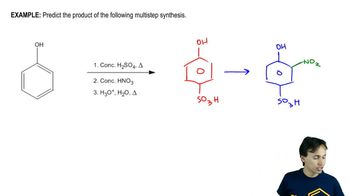
Multistep Synthesis

Multistep synthesis involves a series of chemical reactions that transform starting materials into a desired product through intermediate compounds. Understanding the sequence of reactions, including the reagents and conditions required for each step, is crucial for successfully completing the synthesis. This concept emphasizes the importance of planning and strategy in organic chemistry to achieve complex molecules efficiently.
Video consigliato:
02:15
Multistep Synthesis

Reagents and Solvents

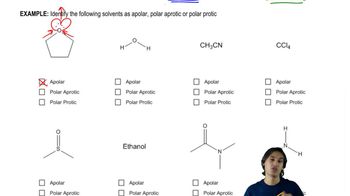
Reagents are substances used to bring about a chemical reaction, while solvents are the mediums in which reactions occur. Selecting appropriate reagents is essential for driving the desired transformations, and the choice of solvent can influence reaction rates, yields, and selectivity. Knowledge of common reagents and solvents, along with their properties, is vital for effective synthesis planning.
Video consigliato:
01:16
Identification of polarity in solvents

Reaction Mechanisms

A reaction mechanism describes the step-by-step sequence of elementary reactions that occur during a chemical transformation. Understanding mechanisms helps predict the products of reactions and the conditions needed for them to proceed. Familiarity with common mechanisms, such as nucleophilic substitution or electrophilic addition, is essential for designing multistep syntheses and troubleshooting potential issues.
Video consigliato:
02:16
Heck Reaction Mechanism