Ch. 20 - Carboxylic Acids
Wade - Organic Chemistry 9th Edition
Wade9th EditionOrganic ChemistryISBN: 9780135213728Non è quello che usi tu?Cambia libro di testo
Capitolo 20, Problema 36b

Show how you would accomplish the following syntheses efficiently (you may use any necessary reagents).
(b) hex-3-ene → propanoic acid

Guida verificata passo dopo passo
1
Step 1: Analyze the starting material (hex-3-ene) and the target product (propanoic acid). Hex-3-ene is an alkene, while propanoic acid is a carboxylic acid. This suggests that the synthesis will involve oxidative cleavage of the alkene followed by conversion of the resulting fragments into carboxylic acids.
Step 2: Perform oxidative cleavage of the alkene using a strong oxidizing agent such as potassium permanganate (KMnO₄) under acidic conditions or ozone (O₃) followed by reductive workup with zinc (Zn) and water. This will break the double bond in hex-3-ene and yield two fragments: propanal (CH₃CH₂CHO) and butanal (CH₃CH₂CH₂CHO).
Step 3: Focus on the fragment that corresponds to propanal (CH₃CH₂CHO), as this is the precursor to propanoic acid. Convert propanal into propanoic acid by oxidizing the aldehyde group (-CHO) to a carboxylic acid (-COOH). This can be achieved using an oxidizing agent such as potassium dichromate (K₂Cr₂O₇) in acidic conditions or Jones reagent (CrO₃ in H₂SO₄).
Step 4: Verify that the other fragment (butanal) is not required for the synthesis of propanoic acid. If necessary, isolate the propanal fragment from the reaction mixture to ensure efficient conversion to propanoic acid.
Step 5: Confirm the structure of the final product (propanoic acid) using spectroscopic techniques such as IR spectroscopy (look for the characteristic C=O stretch of the carboxylic acid group) or NMR spectroscopy (observe the chemical shifts corresponding to the carboxylic acid proton and the alkyl chain).

Risposta video verificata per un problema simile:

Questa soluzione video è stata consigliata dai nostri tutor come utile per risolvere questo problema.
Durata del video:
3m

Concetti chiave

Ecco i concetti essenziali che devi comprendere per rispondere correttamente alla domanda.

Alkenes and Their Reactions

Hex-3-ene is an alkene, characterized by a carbon-carbon double bond. Understanding the reactivity of alkenes is crucial, as they can undergo various reactions such as hydroboration-oxidation, ozonolysis, and hydrogenation. These reactions allow for the transformation of alkenes into alcohols, carbonyl compounds, and other functional groups, which are essential in synthetic pathways.
Video consigliato:
Percorso guidato
2:09
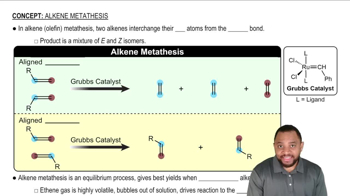
Alkene Metathesis Concept 1

Oxidation Reactions

Oxidation reactions involve the addition of oxygen or the removal of hydrogen, often leading to the formation of carboxylic acids from alkenes. In the case of hex-3-ene, ozonolysis can be employed to cleave the double bond, resulting in the formation of aldehydes or ketones, which can then be further oxidized to yield propanoic acid. Understanding the mechanisms and conditions for these oxidation reactions is vital for efficient synthesis.
Video consigliato:
03:20
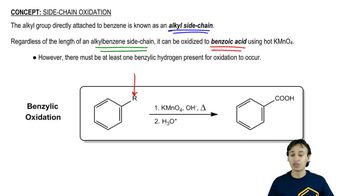
Benzylic Oxidation

Reagents and Conditions

The choice of reagents and reaction conditions is critical in organic synthesis. For converting hex-3-ene to propanoic acid, reagents such as ozone (for ozonolysis) followed by hydrogen peroxide (for oxidation) can be used. Familiarity with the properties and reactivity of these reagents, as well as the conditions under which they operate, is essential for achieving the desired transformation efficiently.
Video consigliato:
01:52
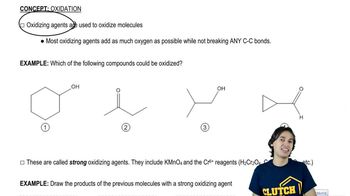
Reagents