Ch. 20 - Carboxylic Acids
Wade - Organic Chemistry 9th Edition
Wade9th EditionOrganic ChemistryISBN: 9780135213728Non è quello che usi tu?Cambia libro di testo
Capitolo 20, Problema 11f

Show how you would synthesize the following carboxylic acids, using the indicated starting materials.
(f) allyl iodide → but-3-enoic acid

Guida verificata passo dopo passo
1
Step 1: Begin by identifying the functional groups in the starting material (allyl iodide) and the target molecule (but-3-enoic acid). Allyl iodide contains an alkyl halide group, while but-3-enoic acid contains a carboxylic acid group and a double bond.
Step 2: Plan the synthesis by considering the transformation of the alkyl halide into a carboxylic acid. A common method involves converting the alkyl halide into a Grignard reagent, which can then react with carbon dioxide to form a carboxylic acid.
Step 3: React allyl iodide with magnesium in dry ether to form allyl magnesium iodide, a Grignard reagent. The reaction can be represented as: CH(2)CH(2)I+Mg→CH(2)CH(2)MgI
Step 4: Bubble carbon dioxide gas through the Grignard reagent solution to form the carboxylic acid intermediate. The reaction can be represented as: CH(2)CH(2)MgI+CO2→CH(2)CH(2)COOH
Step 5: Perform an acidic workup (e.g., using dilute HCl) to protonate the carboxylate ion and isolate the final product, but-3-enoic acid. This step ensures the carboxylic acid is fully formed and purified.

Risposta video verificata per un problema simile:

Questa soluzione video è stata consigliata dai nostri tutor come utile per risolvere questo problema.
Durata del video:
1m

Concetti chiave

Ecco i concetti essenziali che devi comprendere per rispondere correttamente alla domanda.

Carboxylic Acid Synthesis

Carboxylic acids can be synthesized through various methods, including oxidation of alcohols, hydrolysis of nitriles, and carbon chain elongation. Understanding the functional groups and reactivity of starting materials is crucial for determining the appropriate synthetic route. In this case, the transformation of allyl iodide to but-3-enoic acid involves strategic manipulation of carbon skeletons and functional groups.
Video consigliato:
04:20
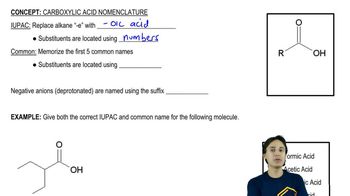
Carboxylic Acids Nomenclature

Allyl Iodide Reactivity

Allyl iodide is a reactive alkyl halide that can undergo nucleophilic substitution and elimination reactions. Its structure allows for the formation of a double bond through elimination, which is essential for synthesizing alkenes. Recognizing how allyl iodide can be transformed into intermediates that lead to the desired carboxylic acid is key to solving the synthesis problem.
Video consigliato:
03:20
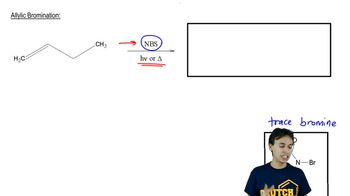
Specific Reactions - Allylic Bromination

Carbon Chain Elongation

Carbon chain elongation involves adding carbon atoms to a molecule, often through reactions like Grignard reactions or alkylation. In the context of synthesizing but-3-enoic acid, understanding how to extend the carbon chain from allyl iodide and subsequently introduce a carboxylic acid functional group is vital. This concept is fundamental in organic synthesis for constructing complex molecules from simpler precursors.
Video consigliato:
04:25
Name the longest carbon chain
Pratica correlata
Domanda del libro di testo

Propose a mechanism for the acid-catalyzed reaction of acetic acid with ethanol to give ethyl acetate.

1456
views

Domanda del libro di testo

The Principle of Microscopic Reversibility states that a forward reaction and a reverse reaction taking place under the same conditions (as in an equilibrium) must follow the same reaction pathway in microscopic detail. The reverse of the Fischer esterification is the acid-catalyzed hydrolysis of an ester. Propose a mechanism for the acid-catalyzed hydrolysis of ethyl benzoate, PhCOOCH2CH3.

729
views
Domanda del libro di testo

Show how you would synthesize the following carboxylic acids, using the indicated starting materials.

(a) oct-4-yne → butanoic acid

(b) trans-cyclodecene → decanedioic acid

763
views
Domanda del libro di testo

Show how you would synthesize the following carboxylic acids, using the indicated starting materials.

(e) p-xylene → terephthalic acid

681
views
Domanda del libro di testo

A carboxylic acid has two oxygen atoms, each with two nonbonding pairs of electrons.

(a) Draw the resonance forms of a carboxylic acid that is protonated on the hydroxy oxygen atom.

(b) Compare the resonance forms with those given previously for an acid protonated on the carbonyl oxygen atom.

(c) Explain why the carbonyl oxygen atom of a carboxylic acid is more basic than the hydroxy oxygen.

1933
views
Domanda del libro di testo

Show how you would synthesize the following carboxylic acids, using the indicated starting materials.

(d) butan-2-ol → 2-methylbutanoic acid

665
views