
Ch. 20 - Carboxylic Acids
Wade - Organic Chemistry 9th Edition
Wade9th EditionOrganic ChemistryISBN: 9780135213728Non è quello che usi tu?Cambia libro di testo
Capitolo 20, Problema 40c

The following NMR spectra correspond to compound of formula (C) C6H10O2. Propose structure, and show how it is consistent with the observed absorptions.
<IMAGE>

Guida verificata passo dopo passo
1
Analyze the molecular formula (C6H10O2) to determine the degree of unsaturation. Use the formula: Degree of Unsaturation = (2C + 2 - H + N - X)/2, where C = number of carbons, H = number of hydrogens, N = number of nitrogens, and X = number of halogens. For this compound, calculate the degree of unsaturation to identify the presence of rings or double bonds.
Examine the NMR spectra for key features. Look for chemical shifts, splitting patterns, and integration values. For example, chemical shifts in the range of 9-10 ppm suggest aldehydes, 2-3 ppm suggest protons near electronegative atoms, and 0-2 ppm suggest alkyl protons. Integration values will help determine the number of protons contributing to each signal.
Identify functional groups based on the NMR data and the molecular formula. For example, if you observe a peak around 170-180 ppm in the 13C NMR spectrum, it may indicate the presence of a carbonyl group (C=O). Combine this information with the degree of unsaturation to narrow down possible structures.
Propose a structure that fits the molecular formula and is consistent with the NMR data. For example, if the degree of unsaturation is 2 and the NMR data suggests a carbonyl group and an ester functional group, consider structures like esters or cyclic ketones.
Verify the proposed structure by matching all observed NMR signals to the protons and carbons in the structure. Ensure that the chemical shifts, splitting patterns, and integration values align with the proposed structure. If discrepancies arise, revisit the analysis and adjust the structure accordingly.

Risposta video verificata per un problema simile:

Questa soluzione video è stata consigliata dai nostri tutor come utile per risolvere questo problema.
Durata del video:
3m

Concetti chiave

Ecco i concetti essenziali che devi comprendere per rispondere correttamente alla domanda.

Nuclear Magnetic Resonance (NMR) Spectroscopy

NMR spectroscopy is a powerful analytical technique used to determine the structure of organic compounds. It relies on the magnetic properties of certain nuclei, primarily hydrogen (1H) and carbon (13C), to provide information about the number of hydrogen atoms, their environment, and connectivity in a molecule. The resulting spectra display peaks that correspond to different chemical environments, allowing chemists to deduce structural features.
Video consigliato:
10:06
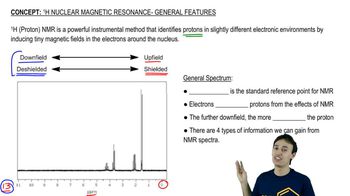
General NMR Features

Chemical Shift

Chemical shift refers to the position of a peak in an NMR spectrum, which indicates the electronic environment surrounding a nucleus. It is measured in parts per million (ppm) and varies based on factors such as electronegativity and hybridization of nearby atoms. Understanding chemical shifts is crucial for interpreting NMR data, as they help identify functional groups and the overall structure of the compound.
Video consigliato:
11:44
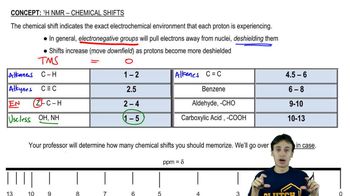
1H NMR Chemical Shifts

Integration and Multiplicity

Integration in NMR refers to the area under a peak, which correlates to the number of protons contributing to that signal. Multiplicity describes the splitting pattern of a peak, indicating how many neighboring protons are present (n+1 rule). Together, integration and multiplicity provide insights into the number of hydrogen atoms in different environments and their connectivity, essential for constructing the molecular structure.
Video consigliato:
06:46
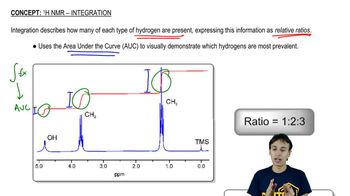
1H NMR Integration
Pratica correlata
Domanda del libro di testo

Two of the methods for converting alkyl halides to carboxylic acids are covered in Sections 20-8B and 20-8C. One is formation of a Grignard reagent followed by addition of carbon dioxide and then dilute acid. The other is substitution by cyanide ion, followed by hydrolysis of the resulting nitrile. For each of the following conversions, decide whether either or both of these methods would work, and explain why. Show the reactions you would use.

(a)

(b)

1817
views
Domanda del libro di testo

Peroxyacetic acid (bp = 105 °C) has a lower boiling point than acetic acid (bp = 118 °C), even though peroxyacetic acid has a higher molecular weight. Explain why peroxyacetic acid is more volatile than acetic acid.

796
views
Domanda del libro di testo

In the presence of a trace of acid, δ-hydroxyvaleric acid forms a cyclic ester (lactone).

(a) Give the structure of the lactone, called δ-valerolactone.

(b) Propose a mechanism for the formation of δ-valerolactone.

1340
views
Domanda del libro di testo

Show how you would accomplish the following multistep syntheses. You may use any additional reagents and solvents you need.

(e)

704
views
Domanda del libro di testo

Show how you would accomplish the following multistep syntheses. You may use any additional reagents and solvents you need.

(f)

1112
views
Domanda del libro di testo

The following NMR spectra correspond to compound of formula (A) C9H10O2. Propose structure, and show how it is consistent with the observed absorptions.

<IMAGE>

3777
views
1
rank