Ch. 21 - Carboxylic Acid Derivatives
Wade - Organic Chemistry 9th Edition
Wade9th EditionOrganic ChemistryISBN: 9780135213728Non è quello che usi tu?Cambia libro di testo
Capitolo 21, Problema 30b

Show how Friedel–Crafts acylation might be used to synthesize the following compounds.
b. benzophenone

Guida verificata passo dopo passo
1
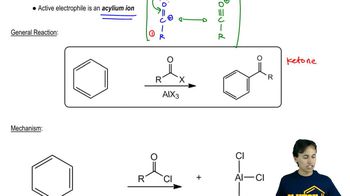
Step 1: Understand the Friedel–Crafts acylation reaction. This reaction involves the introduction of an acyl group (RCO-) into an aromatic ring using an acyl chloride (RCOCl) and a Lewis acid catalyst, typically aluminum chloride (AlCl₃). The reaction proceeds via electrophilic aromatic substitution.
Step 2: Identify the target compound, benzophenone. Benzophenone has two phenyl groups attached to a carbonyl group (C=O). This means one phenyl group will act as the aromatic ring undergoing acylation, while the other phenyl group will be part of the acyl group.
Step 3: Choose the appropriate acylating agent. To synthesize benzophenone, the acylating agent should be benzoyl chloride (C₆H₅COCl), which contains the phenyl group attached to the carbonyl group.
Step 4: Set up the reaction. Combine benzene (C₆H₆) as the aromatic substrate with benzoyl chloride (C₆H₅COCl) in the presence of a Lewis acid catalyst, such as AlCl₃. The AlCl₃ activates the benzoyl chloride by forming a complex, making the carbonyl carbon more electrophilic and susceptible to attack by the benzene ring.
Step 5: Complete the reaction mechanism. The benzene ring donates electrons to the electrophilic carbonyl carbon, forming a sigma complex. The AlCl₃ catalyst helps stabilize the intermediate, and a proton is lost to regenerate the aromaticity of the benzene ring. The final product is benzophenone (C₆H₅COC₆H₅).

Risposta video verificata per un problema simile:

Questa soluzione video è stata consigliata dai nostri tutor come utile per risolvere questo problema.
Durata del video:
1m

Concetti chiave

Ecco i concetti essenziali che devi comprendere per rispondere correttamente alla domanda.

Friedel–Crafts Acylation

Friedel–Crafts acylation is an electrophilic aromatic substitution reaction that introduces an acyl group into an aromatic ring. This reaction typically involves the use of an acyl chloride and a Lewis acid catalyst, such as aluminum chloride, to generate the acylium ion, which then reacts with the aromatic compound. This method is valuable for synthesizing ketones from aromatic compounds.
Video consigliato:
05:20
Friedel-Crafts Acylation

Benzophenone Structure

Benzophenone is an organic compound characterized by two phenyl groups attached to a carbonyl group (C=O). Its structure can be represented as Ph-CO-Ph, where 'Ph' denotes a phenyl group. Understanding the structure of benzophenone is crucial for recognizing how Friedel–Crafts acylation can be applied to synthesize it from simpler aromatic precursors.
Video consigliato:
03:04
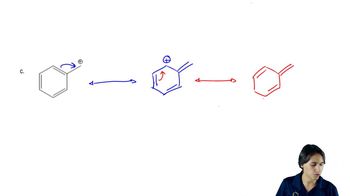
Drawing Resonance Structures

Electrophilic Aromatic Substitution

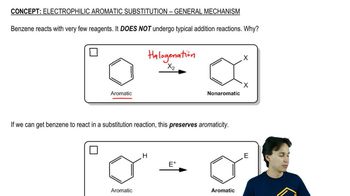
Electrophilic aromatic substitution (EAS) is a fundamental reaction mechanism in organic chemistry where an electrophile replaces a hydrogen atom on an aromatic ring. This process is essential for the synthesis of various aromatic compounds, including benzophenone. The stability of the aromatic system is maintained during the reaction, making EAS a key concept in understanding how acylation can modify aromatic compounds.
Video consigliato:
03:07
EAS Review