Ch. 21 - Carboxylic Acid Derivatives
Wade - Organic Chemistry 9th Edition
Wade9th EditionOrganic ChemistryISBN: 9780135213728Non è quello che usi tu?Cambia libro di testo
Capitolo 21, Problema 34d

Suggest the most appropriate reagent for each synthesis, and explain your choice.
(d)

Guida verificata passo dopo passo
1
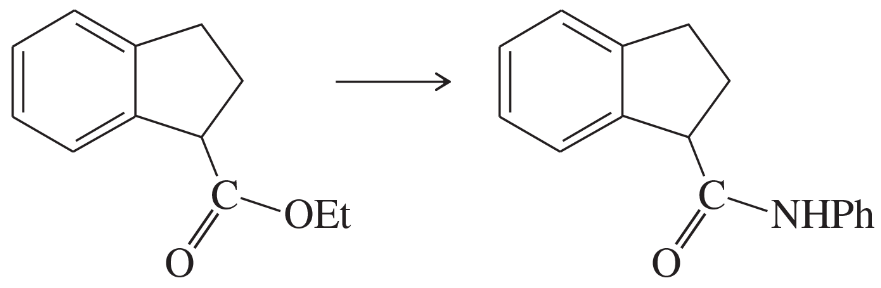
Step 1: Analyze the transformation. The starting material is an ethyl ester (C=O bonded to OEt), and the product is an amide (C=O bonded to NPh). This indicates that the ester group is being converted into an amide group.
Step 2: Identify the type of reaction. The conversion of an ester to an amide typically involves nucleophilic substitution, where the ethoxy group (-OEt) is replaced by an amine group (-NPh).
Step 3: Choose the appropriate reagent. To achieve this transformation, a primary amine (such as aniline, PhNH2) can be used as the nucleophile. Aniline will attack the carbonyl carbon of the ester, leading to the substitution of the ethoxy group.
Step 4: Consider reaction conditions. The reaction may require heating to facilitate the nucleophilic attack and subsequent elimination of ethanol. A solvent like toluene or THF can be used to dissolve the reactants.
Step 5: Explain the choice of reagent. Aniline (PhNH2) is chosen because it provides the phenyl group (-Ph) attached to the nitrogen in the amide product. This matches the structure of the desired product.

Risposta video verificata per un problema simile:

Questa soluzione video è stata consigliata dai nostri tutor come utile per risolvere questo problema.
Durata del video:
1m

Concetti chiave

Ecco i concetti essenziali che devi comprendere per rispondere correttamente alla domanda.

Nucleophilic Acyl Substitution

Nucleophilic acyl substitution is a fundamental reaction in organic chemistry where a nucleophile attacks the carbonyl carbon of an acyl compound, leading to the replacement of a leaving group. In this case, the ester is converted to an amide by the nucleophilic attack of an amine on the carbonyl carbon, resulting in the formation of a new C-N bond and the release of the ethoxy group as a leaving group.
Video consigliato:
01:47
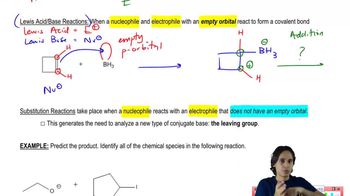
Nucleophiles and Electrophiles can react in Substitution Reactions.

Reactivity of Esters

Esters are relatively reactive compounds due to the presence of the carbonyl group, which is electrophilic and susceptible to nucleophilic attack. The leaving group in esters, such as an alkoxy group, can be displaced by stronger nucleophiles, making them suitable substrates for nucleophilic acyl substitution reactions. Understanding the reactivity of esters is crucial for selecting appropriate reagents for synthesis.
Video consigliato:
02:39
Ester Nomenclature

Choice of Nucleophile

The choice of nucleophile is critical in nucleophilic acyl substitution reactions. In this case, an amine (NHPh) is chosen to convert the ester to an amide. Amines are good nucleophiles due to the presence of a lone pair of electrons on the nitrogen atom, which allows them to effectively attack the electrophilic carbonyl carbon, facilitating the desired transformation.
Video consigliato:
08:27
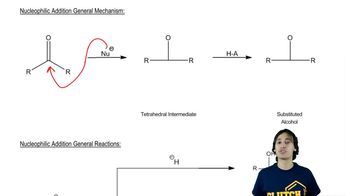
Nucleophilic Addition