Ch. 22 - Condensations and Alpha Substitutions of Carbonyl Compounds
Wade - Organic Chemistry 9th Edition
Wade9th EditionOrganic ChemistryISBN: 9780135213728Non è quello che usi tu?Cambia libro di testo
Capitolo 22, Problema 60e

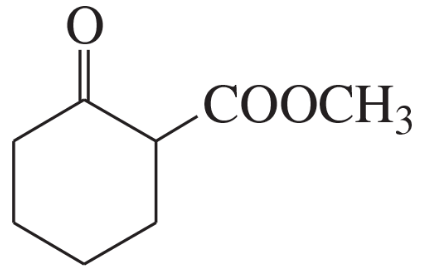
For each molecule shown below,
1. indicate the most acidic hydrogens.
2. draw the important resonance contributors of the anion that results from removal of the most acidic hydrogen.
(e)

Guida verificata passo dopo passo
1
Step 1: Identify the functional groups in the molecule. The molecule contains a ketone group (C=O) and an ester group (COOCH₃). These groups influence the acidity of hydrogens in the molecule due to their electron-withdrawing effects.
Step 2: Determine the most acidic hydrogen. The hydrogens alpha to the ketone group (on the carbon adjacent to the C=O group) are the most acidic. This is because the negative charge formed upon deprotonation can be stabilized by resonance with the ketone group.
Step 3: Remove the most acidic hydrogen to form the anion. Deprotonation of the alpha hydrogen results in a carbanion on the alpha carbon.
Step 4: Draw the resonance contributors of the resulting anion. The negative charge on the alpha carbon can delocalize into the ketone group, forming resonance structures where the negative charge is on the oxygen atom of the ketone group. Additionally, the ester group may also participate in resonance stabilization.
Step 5: Ensure all resonance structures are valid. Verify that each resonance structure follows the rules of resonance, including maintaining the octet rule for all atoms and proper placement of charges.

Risposta video verificata per un problema simile:

Questa soluzione video è stata consigliata dai nostri tutor come utile per risolvere questo problema.
Durata del video:
3m

Concetti chiave

Ecco i concetti essenziali che devi comprendere per rispondere correttamente alla domanda.

Acidity of Hydrogens

In organic chemistry, the acidity of a hydrogen atom is determined by its ability to be removed as a proton (H+). Factors influencing acidity include the electronegativity of the atom to which the hydrogen is attached, the stability of the resulting anion, and the presence of electron-withdrawing groups. In the given molecule, the most acidic hydrogens are typically those adjacent to carbonyl groups or other electronegative atoms.
Video consigliato:
00:48
The definition of hydrogenation.

Resonance Structures

Resonance structures are different ways of drawing a molecule that represent the same compound, showing the delocalization of electrons. In the context of the question, after removing the most acidic hydrogen, the resulting anion can be stabilized by resonance, where the negative charge is distributed over multiple atoms. This delocalization lowers the energy of the anion, making it more stable.
Video consigliato:
03:04
Drawing Resonance Structures

Anion Stability

The stability of an anion is crucial in determining the acidity of the corresponding acid. Anions that can delocalize their negative charge through resonance or are stabilized by inductive effects from nearby electronegative atoms are generally more stable. In the case of the molecule provided, the anion formed after deprotonation will be more stable due to resonance with the carbonyl group, which can help distribute the negative charge.
Video consigliato:
Percorso guidato
0:53
Anionic Polymerization Concept 3