Ch. 22 - Condensations and Alpha Substitutions of Carbonyl Compounds
Wade - Organic Chemistry 9th Edition
Wade9th EditionOrganic ChemistryISBN: 9780135213728Non è quello che usi tu?Cambia libro di testo
Capitolo 22, Problema 1c3

Phenylacetone can form two different enols.
(c) Propose mechanisms for the formation of the first enol in base.

Guida verificata passo dopo passo
1
Identify the structure of phenylacetone: It is a ketone with a phenyl group attached to the alpha-carbon. The molecular structure can be represented as C6H5-CH2-CO-CH3.
Understand the concept of enol formation: Enols are formed when a hydrogen atom from the alpha-carbon (the carbon adjacent to the carbonyl group) is removed, and the resulting negative charge is delocalized to form a double bond between the alpha-carbon and the carbonyl carbon, while the oxygen of the carbonyl group gains a proton to form an -OH group.
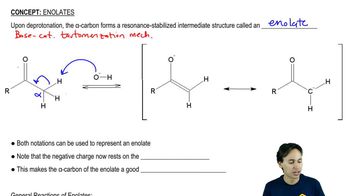
Initiate the mechanism in base: A strong base (e.g., hydroxide ion, OH⁻) abstracts an acidic proton from the alpha-carbon of phenylacetone. This generates a resonance-stabilized enolate ion.
Illustrate resonance stabilization: The enolate ion has two resonance forms. In one form, the negative charge is on the alpha-carbon, and in the other, the negative charge is delocalized onto the oxygen atom of the carbonyl group. This delocalization stabilizes the intermediate.
Complete the enol formation: The enolate ion reacts with a proton donor (e.g., water) to protonate the oxygen atom, forming the enol. The final structure of the enol will have a double bond between the alpha-carbon and the carbonyl carbon, and the oxygen will be part of a hydroxyl (-OH) group.

Risposta video verificata per un problema simile:

Questa soluzione video è stata consigliata dai nostri tutor come utile per risolvere questo problema.
Durata del video:
2m

Concetti chiave

Ecco i concetti essenziali che devi comprendere per rispondere correttamente alla domanda.

Enol Formation

Enol formation involves the conversion of a carbonyl compound, such as a ketone or aldehyde, into its corresponding enol form, which features a double bond between a carbon and an adjacent carbon with a hydroxyl group. This process is significant in organic chemistry as enols can participate in various reactions, including tautomerization and electrophilic addition.
Video consigliato:
02:26
Formation of Enolates

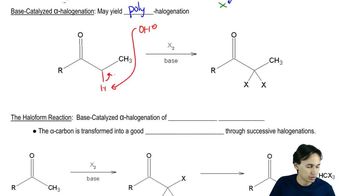
Base-Catalyzed Mechanism

In a base-catalyzed mechanism, a base abstracts a proton from the carbon adjacent to the carbonyl group, generating a carbanion. This carbanion can then attack the carbonyl carbon, leading to the formation of the enolate ion, which can subsequently rearrange to form the enol. Understanding this mechanism is crucial for predicting the products of reactions involving carbonyl compounds.
Video consigliato:
01:57
Base Catalyzed

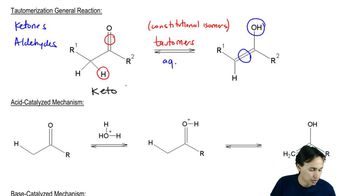
Tautomerization

Tautomerization is a chemical reaction that involves the interconversion between two isomers, typically a keto form and an enol form. This process is often facilitated by the presence of acids or bases and is important in understanding the stability and reactivity of different isomers in organic compounds, including phenylacetone.
Video consigliato:
05:11
Tautomerization Mechanisms