Ch. 22 - Condensations and Alpha Substitutions of Carbonyl Compounds
Wade - Organic Chemistry 9th Edition
Wade9th EditionOrganic ChemistryISBN: 9780135213728Non è quello che usi tu?Cambia libro di testo
Capitolo 22, Problema 69h

Predict the products of the following reactions.
(h) Chemical structure of acetoacetic ester synthesis with reaction conditions and reagents listed on the right.

Guida verificata passo dopo passo
1
Step 1: Analyze the structure of the starting compound. The molecule contains two carbonyl groups: one in a ketone functional group and the other in an ester functional group. The reaction involves three steps: (1) treatment with sodium methoxide (NaOCH₃), (2) methyl iodide (CH₃I), and (3) acidic hydrolysis with heat (H₃O⁺, heat).
Step 2: In the first step, NaOCH₃ acts as a base and deprotonates the alpha-hydrogen (hydrogen adjacent to the ketone carbonyl group). This generates an enolate ion, which is a nucleophilic species capable of attacking electrophiles.
Step 3: In the second step, the enolate ion reacts with CH₃I, an alkylating agent. The enolate attacks the methyl group of CH₃I, resulting in the formation of a new C-C bond. This step introduces a methyl group at the alpha position of the ketone.
Step 4: In the third step, the molecule undergoes acidic hydrolysis (H₃O⁺, heat). The ester group is hydrolyzed to form a carboxylic acid. Additionally, decarboxylation may occur if the molecule contains a beta-keto acid structure after hydrolysis, leading to the loss of CO₂.
Step 5: The final product is a methylated ketone (due to the alkylation step) and potentially a simpler ketone structure if decarboxylation occurs. Carefully examine the reaction conditions and intermediates to predict the exact structure of the product.

Risposta video verificata per un problema simile:

Questa soluzione video è stata consigliata dai nostri tutor come utile per risolvere questo problema.
Durata del video:
3m

Concetti chiave

Ecco i concetti essenziali che devi comprendere per rispondere correttamente alla domanda.

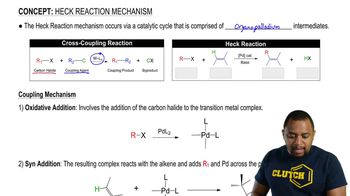
Reaction Mechanisms

Understanding reaction mechanisms is crucial in organic chemistry as they describe the step-by-step process by which reactants transform into products. This includes identifying intermediates, transition states, and the movement of electrons. Familiarity with mechanisms helps predict the outcome of reactions and the stability of products formed.
Video consigliato:
02:16
Heck Reaction Mechanism

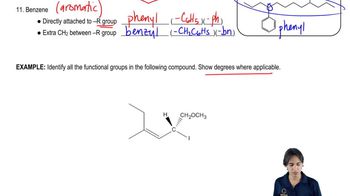
Functional Groups

Functional groups are specific groups of atoms within molecules that are responsible for the characteristic chemical reactions of those molecules. Recognizing functional groups allows chemists to predict reactivity and the types of products that can be formed during chemical reactions. Common functional groups include alcohols, carboxylic acids, and amines.
Video consigliato:
02:36
Identifying Functional Groups

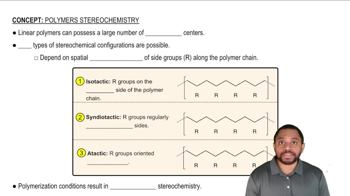
Stereochemistry

Stereochemistry involves the study of the spatial arrangement of atoms in molecules and how this affects their chemical behavior. It is essential for predicting the products of reactions, especially in cases where chirality or geometric isomerism is involved. Understanding stereochemistry helps in determining the specific isomers that may be produced in a reaction.
Video consigliato:
Percorso guidato
1:38
Polymer Stereochemistry Concept 1