Ch. 23 - Carbohydrates and Nucleic Acids
Wade - Organic Chemistry 9th Edition
Wade9th EditionOrganic ChemistryISBN: 9780135213728Non è quello che usi tu?Cambia libro di testo
Capitolo 23, Problema 25b

Show what happens when the product of part (a) is hydrolyzed using dilute acid.

Guida verificata passo dopo passo
1
Identify the product from part (a) and determine its functional groups. For example, if the product contains an ester group, hydrolysis will target this functional group.
Understand the mechanism of acid-catalyzed hydrolysis. In this reaction, the ester group reacts with water in the presence of a dilute acid (e.g., HCl or H2SO4) to form a carboxylic acid and an alcohol.
Write the general reaction for acid-catalyzed hydrolysis: ROOR+H2O→ROH+RCOOH, where R represents alkyl or aryl groups.
Propose the specific hydrolysis reaction for the product of part (a). Replace the generic R groups in the general reaction with the actual groups from the product of part (a).
Draw the structures of the resulting products (e.g., the carboxylic acid and alcohol) and ensure that the reaction is balanced. Verify that the hydrolysis mechanism is consistent with the functional groups present in the product of part (a).

Risposta video verificata per un problema simile:

Questa soluzione video è stata consigliata dai nostri tutor come utile per risolvere questo problema.
Durata del video:
5m

Concetti chiave

Ecco i concetti essenziali che devi comprendere per rispondere correttamente alla domanda.

Hydrolysis

Hydrolysis is a chemical reaction involving the breaking of a bond in a molecule using water. In organic chemistry, it often refers to the reaction of a compound with water or an aqueous solution, leading to the formation of new products. When hydrolyzing an organic compound, such as an ester or an amide, the reaction typically results in the formation of an alcohol and a carboxylic acid or an amine, respectively.
Video consigliato:
Percorso guidato
1:00
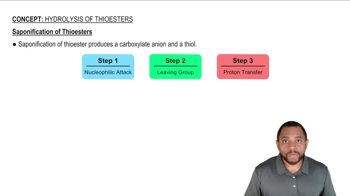
Hydrolysis of Thioesters Concept 2

Dilute Acid

A dilute acid is an acid that has been mixed with a significant amount of water, reducing its concentration. In hydrolysis reactions, dilute acids, such as hydrochloric acid (HCl) or sulfuric acid (H2SO4), are often used as catalysts to facilitate the reaction. The presence of a dilute acid can help to protonate the reactants, making them more reactive and promoting the cleavage of bonds during hydrolysis.
Video consigliato:
02:23
Using factors affecting acidity to rank acids

Reaction Mechanism

A reaction mechanism is a step-by-step description of the process by which reactants are converted into products in a chemical reaction. Understanding the mechanism of hydrolysis is crucial, as it involves several stages, including protonation of the substrate, nucleophilic attack by water, and subsequent bond cleavage. This knowledge helps predict the products formed and the conditions required for the reaction to proceed efficiently.
Video consigliato:
02:16
Heck Reaction Mechanism