

Ch. 23 - Carbohydrates and Nucleic Acids
Wade - Organic Chemistry 9th Edition
Wade9th EditionOrganic ChemistryISBN: 9780135213728Non è quello che usi tu?Cambia libro di testo
Capitolo 23, Problema 36

Draw the structures of the individual mutarotating α and β anomers of maltose.

Guida verificata passo dopo passo
1
Understand the concept of mutarotation: Mutarotation is the change in the optical rotation due to the interconversion between α and β anomers of a sugar in solution. Maltose is a disaccharide composed of two glucose units linked by an α(1→4) glycosidic bond.
Identify the structure of maltose: Maltose consists of two glucose molecules. The first glucose unit has a free anomeric carbon (C1), which can exist in either the α or β configuration. The second glucose unit is locked in its pyranose form due to the glycosidic bond.
Draw the α-anomer of maltose: In the α-anomer, the hydroxyl group (-OH) on the anomeric carbon (C1) of the first glucose unit is positioned *axially* (down) in the Haworth projection. The second glucose unit remains unchanged in its pyranose form.
Draw the β-anomer of maltose: In the β-anomer, the hydroxyl group (-OH) on the anomeric carbon (C1) of the first glucose unit is positioned *equatorially* (up) in the Haworth projection. Again, the second glucose unit remains unchanged.
Label the structures: Clearly label the α and β anomers of maltose to distinguish them. Ensure that the glycosidic bond between the two glucose units is shown as an α(1→4) linkage in both cases, as this does not change during mutarotation.

Risposta video verificata per un problema simile:

Questa soluzione video è stata consigliata dai nostri tutor come utile per risolvere questo problema.
Durata del video:
9m

Concetti chiave

Ecco i concetti essenziali che devi comprendere per rispondere correttamente alla domanda.

Anomers

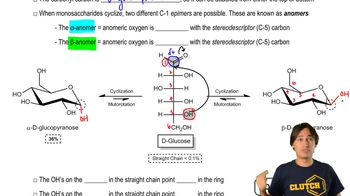
Anomers are a specific type of stereoisomer found in carbohydrates, differing at the anomeric carbon, which is the carbon atom that becomes a new chiral center when a sugar cyclizes. In the case of maltose, the α and β anomers refer to the orientation of the hydroxyl group attached to the anomeric carbon. The α-anomer has the hydroxyl group pointing down, while the β-anomer has it pointing up, leading to distinct structural and chemical properties.
Video consigliato:
12:58
Monosaccharides - Cyclization

Mutarotation

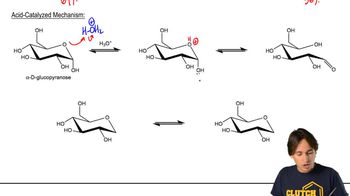
Mutarotation is the process by which a sugar molecule interconverts between its anomeric forms in solution, resulting in a change in optical rotation. This phenomenon occurs due to the equilibrium between the open-chain form and the cyclic forms of the sugar. For maltose, this means that the α and β anomers can interconvert, affecting the overall concentration of each form in solution over time.
Video consigliato:
03:06
Mechanism

Maltose Structure

Maltose is a disaccharide composed of two glucose units linked by an α(1→4) glycosidic bond. Understanding the structure of maltose is crucial for drawing its anomers, as the configuration at the anomeric carbon determines whether it is the α or β form. The structural representation includes the cyclic forms of glucose, which can be depicted using Haworth projections to clearly show the orientation of substituents around the anomeric carbon.
Video consigliato:
03:04
Drawing Resonance Structures
Pratica correlata
Domanda del libro di testo

In 1891, Emil Fischer determined the structures of glucose and the seven other D-aldohexoses using only simple chemical reactions and clever reasoning about stereochemistry and symmetry. He received the Nobel Prize for this work in 1902. Fischer had determined that D-glucose is an aldohexose, and he used Ruff degradations to degrade it to (+)-glyceraldehyde. Therefore, the eight D-aldohexose structures shown in Figure 23-3 are the possible structures for glucose.

Pretend that no names are shown in Figure 23-3 except for glyceraldehyde, and use the following results to prove which of these structures represent glucose, mannose, arabinose, and erythrose.

(a) Upon Ruff degradation, glucose and mannose give the same aldopentose: arabinose. Nitric acid oxidation of arabinose gives an optically active aldaric acid. What are the two possible structures of arabinose?

896
views
Domanda del libro di testo

The Wohl degradation, an alternative to the Ruff degradation, is nearly the reverse of the Kiliani–Fischer synthesis. The aldose carbonyl group is converted to the oxime, which is dehydrated by acetic anhydride to the nitrile (a cyanohydrin). Cyanohydrin formation is reversible, and a basic hydrolysis allows the cyanohydrin to lose HCN. Using the following sequence of reagents, give equations for the individual reactions in the Wohl degradation of D-arabinose to D-erythrose. Mechanisms are not required.

a. hydroxylamine hydrochloride

b. acetic anhydride

c. –OH, H2O

1777
views
Domanda del libro di testo

Give an equation to show the reduction of Tollens reagent by maltose.

1003
views
Domanda del libro di testo

Is gentiobiose a reducing sugar? Does it mutarotate? Explain your reasoning

1481
views
Domanda del libro di testo

In 1891, Emil Fischer determined the structures of glucose and the seven other D-aldohexoses using only simple chemical reactions and clever reasoning about stereochemistry and symmetry. He received the Nobel Prize for this work in 1902. Fischer had determined that D-glucose is an aldohexose, and he used Ruff degradations to degrade it to (+)-glyceraldehyde. Therefore, the eight D-aldohexose structures shown in Figure 23-3 are the possible structures for glucose.

Pretend that no names are shown in Figure 23-3 except for glyceraldehyde, and use the following results to prove which of these structures represent glucose, mannose, arabinose, and erythrose.

(b) Upon Ruff degradation, arabinose gives the aldotetrose erythrose. Nitric acid oxidation of erythrose gives an optically inactive aldaric acid, meso-tartaric acid. What is the structure of erythrose?

821
views
Domanda del libro di testo

Does lactose mutarotate? Is it a reducing sugar? Explain. Draw the two anomeric forms of lactose

876
views