Ch. 23 - Carbohydrates and Nucleic Acids
Wade - Organic Chemistry 9th Edition
Wade9th EditionOrganic ChemistryISBN: 9780135213728Non è quello che usi tu?Cambia libro di testo
Capitolo 23, Problema 22

The mechanism of glycoside formation is the same as the second part of the mechanism for acetal formation. Propose a mechanism for the formation of methyl β-D-glucopyranoside.

Guida verificata passo dopo passo
1
Start by identifying the reactants: D-glucose (a monosaccharide) and methanol (CH₃OH). The reaction typically occurs in the presence of an acid catalyst, such as HCl or H₂SO₄, to facilitate the process.
Protonate the anomeric hydroxyl group (-OH) of D-glucose using the acid catalyst. This step increases the electrophilicity of the anomeric carbon, making it more susceptible to nucleophilic attack.
After protonation, the anomeric hydroxyl group leaves as water (H₂O), forming a resonance-stabilized oxocarbenium ion intermediate. This intermediate is crucial for the reaction to proceed.
Methanol (CH₃OH) acts as a nucleophile and attacks the positively charged anomeric carbon of the oxocarbenium ion. This step forms a new bond between the anomeric carbon and the oxygen of methanol.
Finally, deprotonate the methanol group attached to the anomeric carbon to neutralize the charge and form methyl β-D-glucopyranoside. The β-configuration is determined by the stereochemistry of the nucleophilic attack on the oxocarbenium ion.

Risposta video verificata per un problema simile:

Questa soluzione video è stata consigliata dai nostri tutor come utile per risolvere questo problema.

Concetti chiave

Ecco i concetti essenziali che devi comprendere per rispondere correttamente alla domanda.

Glycoside Formation

Glycoside formation involves the reaction between a sugar and an alcohol, resulting in the creation of a glycosidic bond. This process typically requires an acid catalyst to protonate the hydroxyl group of the sugar, making it a better leaving group. The alcohol then attacks the anomeric carbon, leading to the formation of the glycoside. Understanding this mechanism is crucial for proposing the formation of methyl β-D-glucopyranoside.
Video consigliato:
12:17
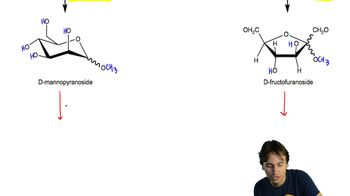
Predict the structure of the glycoside products

Acetal Formation

Acetal formation is a reaction where an aldehyde or ketone reacts with an alcohol in the presence of an acid catalyst to form an acetal. This process involves the nucleophilic attack of the alcohol on the carbonyl carbon, followed by the loss of water and the formation of a stable acetal. The similarity between glycoside and acetal formation lies in the mechanism, where both involve nucleophilic attack and the formation of a new bond, which is essential for understanding the proposed mechanism.
Video consigliato:
04:29
Acetal Protecting Group

Mechanism of Nucleophilic Substitution

The mechanism of nucleophilic substitution is fundamental in organic chemistry, where a nucleophile replaces a leaving group in a molecule. In the context of glycoside formation, the alcohol acts as the nucleophile, attacking the electrophilic carbon of the sugar. This process can occur via either an SN1 or SN2 mechanism, depending on the structure of the substrate and the conditions. Recognizing this mechanism is vital for accurately proposing the steps involved in synthesizing methyl β-D-glucopyranoside.
Video consigliato:
01:47
Nucleophiles and Electrophiles can react in Substitution Reactions.