
Ch. 23 - Carbohydrates and Nucleic Acids
Wade - Organic Chemistry 9th Edition
Wade9th EditionOrganic ChemistryISBN: 9780135213728Non è quello che usi tu?Cambia libro di testo
Capitolo 23, Problema 18

Two sugars, A and B, are known to be glucose and galactose, but it is not certain which one is which. On treatment with nitric acid, A gives an optically inactive aldaric acid, while B gives an optically active aldaric acid. Which sugar is glucose, and which is galactose?

Guida verificata passo dopo passo
1
Identify the structural difference between glucose and galactose. Both are aldohexoses, but they differ in the configuration of the hydroxyl group at carbon-4. Glucose has the hydroxyl group on the right (D-configuration), while galactose has it on the left (L-configuration).
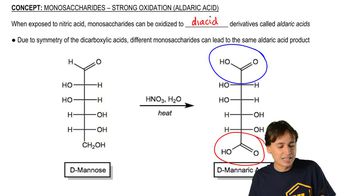
Understand the reaction with nitric acid. When aldoses are treated with nitric acid, both the aldehyde group at C-1 and the primary alcohol group at C-6 are oxidized to carboxylic acids, forming an aldaric acid.
Analyze the optical activity of the aldaric acids. If the aldaric acid is optically inactive, it must be a meso compound, meaning it has an internal plane of symmetry. If it is optically active, it lacks such symmetry.
Determine which sugar corresponds to the optically inactive aldaric acid. Glucose, when oxidized to glucaric acid, forms a meso compound because its structure becomes symmetric. Therefore, sugar A, which gives an optically inactive aldaric acid, is glucose.
Conclude that sugar B, which gives an optically active aldaric acid, must be galactose. This is because galactaric acid (from galactose) is not symmetric and retains optical activity.

Risposta video verificata per un problema simile:

Questa soluzione video è stata consigliata dai nostri tutor come utile per risolvere questo problema.
Durata del video:
4m

Concetti chiave

Ecco i concetti essenziali che devi comprendere per rispondere correttamente alla domanda.

Aldaric Acids

Aldaric acids are dicarboxylic acids derived from aldoses, where the aldehyde group is oxidized to a carboxylic acid. In this context, both glucose and galactose can be converted to their respective aldaric acids upon treatment with nitric acid. The optical activity of these acids can provide insights into the stereochemistry of the original sugars.
Video consigliato:
03:10
Monosaccharides - Strong Oxidation (Aldaric Acid)

Optical Activity

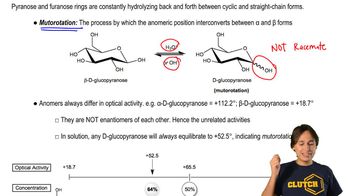
Optical activity refers to the ability of a compound to rotate the plane of polarized light, which is a characteristic of chiral molecules. Glucose and galactose are both chiral, but their aldaric acids can exhibit different optical activities based on their structural configurations. An optically inactive aldaric acid indicates a symmetrical structure, while an optically active one suggests asymmetry.
Video consigliato:
08:17
Mutorotation and Optical Activity

Stereochemistry of Sugars

Stereochemistry involves the study of the spatial arrangement of atoms in molecules and how this affects their chemical behavior. Glucose and galactose are stereoisomers differing in the configuration around one of their carbon atoms. Understanding their stereochemistry is crucial for predicting the products of their reactions, such as the formation of aldaric acids.
Video consigliato:
08:42
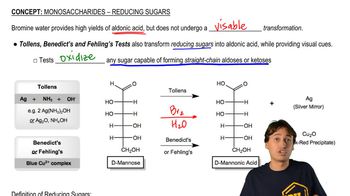
Reducing Sugars
Pratica correlata
Domanda del libro di testo

Except for the Tollens test, basic aqueous conditions are generally avoided with sugars because they lead to fast isomerizations.

(a) Under basic conditions, the proton alpha to the aldehyde (or ketone) carbonyl group is reversibly removed, and the resulting enolate ion is no longer asymmetric. Reprotonation can occur on either face of the enolate, giving either the original structure or its epimer. Because a mixture of epimers results, this process is called epimerization. Propose a mechanism for the base-catalyzed equilibration of glucose to a mixture of glucose and its C2 epimer, mannose.

1085
views
Domanda del libro di testo

Except for the Tollens test, basic aqueous conditions are generally avoided with sugars because they lead to fast isomerizations.

(b) Propose a mechanism for the isomerization of a ketose to an aldose, via the enediol intermediate, shown immediately above. Note that the enediol has two –OH protons, and removing one or the other gives two different enolate ions.

431
views
Domanda del libro di testo

When D-glucose is reduced with sodium borohydride, optically active glucitol results. When optically active D-galactose is reduced, however, the product is optically inactive. Explain this loss of optical activity.

947
views
Domanda del libro di testo

Draw and name the products of bromine water oxidation of

(a) D-mannose

(b) D-galactose

(c) D-fructose

1085
views
Domanda del libro di testo

Draw and name the products of nitric acid oxidation of

(a) D-mannose

(b) D-galactose

1754
views
Domanda del libro di testo

Which of the following are reducing sugars? Comment on the common name sucrose for table sugar.

(c) α-D-allopyranose

(d) ethyl β-D-ribofuranoside

1226
views