Ch. 23 - Carbohydrates and Nucleic Acids
Wade - Organic Chemistry 9th Edition
Wade9th EditionOrganic ChemistryISBN: 9780135213728Non è quello che usi tu?Cambia libro di testo
Capitolo 23, Problema 47d

Without referring to the chapter, draw the chair conformations of
(d) N-acetylglucosamine, glucose with the C2 oxygen atom replaced by an acetylated amino group.

Guida verificata passo dopo passo
1
Understand the structure of N-acetylglucosamine: It is a derivative of glucose where the hydroxyl group (-OH) on the C2 carbon is replaced by an acetylated amino group (-NHCOCH3). Familiarize yourself with the basic structure of glucose in its chair conformation to proceed.
Draw the basic chair conformation of glucose: Start by sketching the six-membered pyranose ring in its chair form. Label the carbon atoms from C1 to C6, ensuring the correct orientation of substituents (hydroxyl groups and hydrogen atoms) based on the D-glucose configuration.
Modify the C2 substituent: Replace the hydroxyl group (-OH) on the C2 carbon with an acetylated amino group (-NHCOCH3). Ensure that the orientation (axial or equatorial) of the substituent matches the original orientation of the hydroxyl group in glucose.
Verify the stereochemistry: Check that the stereochemistry of the other substituents (on C1, C3, C4, and C5) remains consistent with the D-glucose configuration. Ensure that the substituents alternate between axial and equatorial positions as appropriate.
Finalize the drawing: Clearly label the acetylated amino group on C2 and ensure that all substituents are correctly placed. Double-check the chair conformation for accuracy and stability, ensuring that bulky groups are in equatorial positions when possible to minimize steric hindrance.

Risposta video verificata per un problema simile:

Questa soluzione video è stata consigliata dai nostri tutor come utile per risolvere questo problema.
Durata del video:
3m

Concetti chiave

Ecco i concetti essenziali che devi comprendere per rispondere correttamente alla domanda.

Chair Conformation

The chair conformation is a three-dimensional representation of cyclohexane that minimizes steric strain and torsional strain. It allows for the most stable arrangement of substituents on the ring, with axial and equatorial positions that influence the molecule's overall stability and reactivity. Understanding how to draw and interpret chair conformations is crucial for analyzing the spatial arrangement of substituents in cyclic compounds.
Video consigliato:
03:29
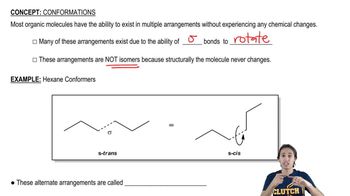
Understanding what a conformer is.

Substituent Effects

Substituent effects refer to how different groups attached to a cyclohexane ring influence its stability and conformation. Groups can be bulky or small, and their position (axial or equatorial) can lead to steric hindrance or favorable interactions. Recognizing the impact of substituents, such as the acetylated amino group in N-acetylglucosamine, is essential for predicting the preferred chair conformation.
Video consigliato:
Percorso guidato
2:02
Directing Effects in Substituted Pyrroles, Furans, and Thiophenes Concept 1

Anomeric Effect

The anomeric effect is a phenomenon observed in carbohydrate chemistry where the orientation of substituents at the anomeric carbon (the carbon derived from the carbonyl carbon during ring formation) can influence the stability of the molecule. This effect can lead to preferential axial or equatorial positioning of substituents, affecting the overall conformation of sugars like glucose and its derivatives. Understanding this effect is important for accurately drawing and predicting the behavior of sugar derivatives.
Video consigliato:
Percorso guidato
2:02
Directing Effects in Substituted Pyrroles, Furans, and Thiophenes Concept 1