
Ch. 24 - Amino Acids, Peptides, and Proteins
Wade - Organic Chemistry 9th Edition
Wade9th EditionOrganic ChemistryISBN: 9780135213728Non è quello che usi tu?Cambia libro di testo
Capitolo 24, Problema 1d

Draw three-dimensional representations of the following amino acids.
(d) L-tryptophan

Guida verificata passo dopo passo
1
Understand the structure of L-tryptophan: L-tryptophan is an amino acid with a chiral center. It contains an indole functional group (a bicyclic structure with a benzene ring fused to a pyrrole ring), an amino group (-NH₂), a carboxylic acid group (-COOH), and a side chain attached to the alpha carbon.
Identify the stereochemistry: The 'L' designation indicates that the amino acid is in the L-configuration, which corresponds to the S-configuration for most amino acids (except cysteine). This means the groups around the alpha carbon are arranged in a specific three-dimensional orientation.
Position the groups around the alpha carbon: In a three-dimensional representation, place the alpha carbon at the center. Attach the carboxylic acid group (-COOH) above the plane, the amino group (-NH₂) to the left, the hydrogen atom below the plane, and the indole-containing side chain to the right. This arrangement follows the CORN rule when viewed with the hydrogen atom pointing away.
Draw the indole side chain: The side chain of tryptophan consists of a methylene group (-CH₂) attached to the alpha carbon, which is then connected to the indole group. Represent the indole group as a fused bicyclic structure with alternating double bonds in the benzene ring and a nitrogen atom in the pyrrole ring.
Finalize the three-dimensional drawing: Use wedge-and-dash notation to indicate the spatial arrangement of the groups. Solid wedges represent bonds coming out of the plane toward the viewer, dashed wedges represent bonds going behind the plane, and straight lines represent bonds in the plane. Ensure the stereochemistry matches the L-configuration.

Risposta video verificata per un problema simile:

Questa soluzione video è stata consigliata dai nostri tutor come utile per risolvere questo problema.
Durata del video:
2m

Concetti chiave

Ecco i concetti essenziali che devi comprendere per rispondere correttamente alla domanda.

Amino Acid Structure

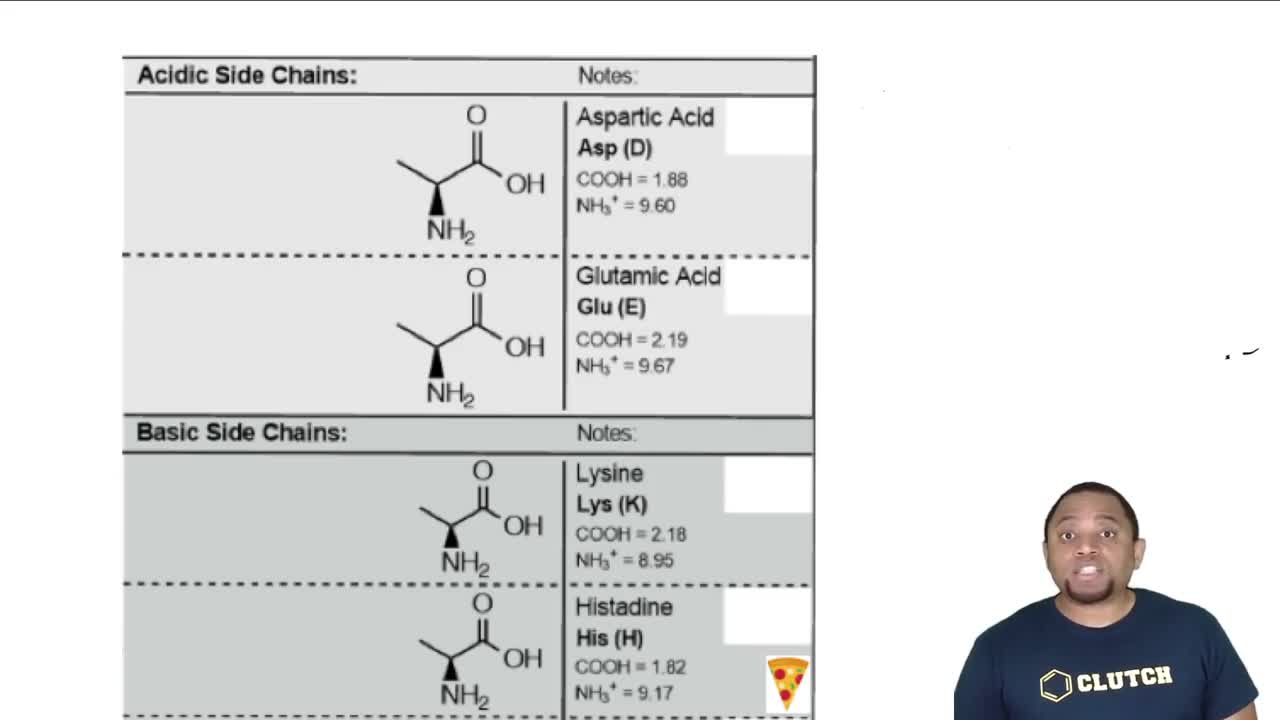
Amino acids are organic compounds composed of a central carbon atom, an amino group (-NH2), a carboxyl group (-COOH), a hydrogen atom, and a variable side chain (R group). The side chain determines the unique properties of each amino acid, influencing its role in protein structure and function.
Video consigliato:
7:19
Charged Amino Acids

Chirality in Amino Acids

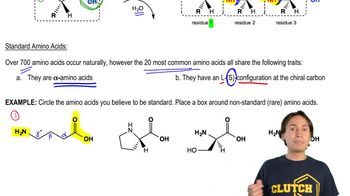
Most amino acids, except glycine, are chiral, meaning they exist in two enantiomeric forms that are mirror images of each other. The 'L' and 'D' nomenclature refers to the configuration around the chiral carbon, with L-forms being the predominant type found in proteins. Understanding chirality is essential for accurately representing amino acids in three-dimensional structures.
Video consigliato:
09:36
Standard Amino Acids

Three-Dimensional Molecular Representation

Three-dimensional representations of molecules, such as amino acids, can be depicted using various models, including ball-and-stick and space-filling models. These representations help visualize the spatial arrangement of atoms, bond angles, and molecular geometry, which are crucial for understanding the interactions and functions of amino acids in biological systems.
Video consigliato:
07:44
Molecular Geometry Explained.
Pratica correlata
Domanda del libro di testo

Most naturally occurring amino acids have chiral centers (the asymmetric α carbon atoms) that are named (S) by the Cahn–Ingold–Prelog convention (Section 5-3). The common naturally occurring form of cysteine has a chiral center that is named (R), however.

(a) What is the relationship between (R)-cysteine and (S)-alanine? Do they have the opposite three-dimensional configuration (as the names might suggest) or the same configuration?

1368
views
Domanda del libro di testo

Draw three-dimensional representations of the following amino acids.

(a) L-phenylalanine

1426
views
Domanda del libro di testo

Draw three-dimensional representations of the following amino acids.

(c) D-serine

953
views
Domanda del libro di testo

The herbicide glyphosate (Roundup®) kills plants by inhibiting an enzyme needed for synthesis of phenylalanine. Deprived of phenylalanine, the plant cannot make the proteins it needs, and it gradually weakens and dies. Although a small amount of glyphosate is deadly to a plant, its human toxicity is quite low. Suggest why this powerful herbicide has little effect on humans.

1969
views
Domanda del libro di testo

Most naturally occurring amino acids have chiral centers (the asymmetric α carbon atoms) that are named (S) by the Cahn–Ingold–Prelog convention (Section 5-3). The common naturally occurring form of cysteine has a chiral center that is named (R), however.

(b) (S)-Alanine is an L-amino acid (Figure 24-2). Is (R)-cysteine a d-amino acid or an L-amino acid?

731
views
Domanda del libro di testo

Draw three-dimensional representations of the following amino acids.

(b) L-histidine

952
views