Ch. 24 - Amino Acids, Peptides, and Proteins
Wade - Organic Chemistry 9th Edition
Wade9th EditionOrganic ChemistryISBN: 9780135213728Non è quello che usi tu?Cambia libro di testo
Capitolo 24, Problema 29d

Predict the products of the following reactions.
(d) Chemical reaction scheme for (D,L)-proline with reagents and conditions listed for amine alkylation.

Guida verificata passo dopo passo
1
Step 1: Analyze the starting material, (D,L)-proline. Proline is an amino acid with a secondary amine group and a carboxylic acid group. The (D,L) designation indicates a racemic mixture containing both enantiomers.
Step 2: Examine the first reagent, excess Ac2O (acetic anhydride). Acetic anhydride reacts with both the amine and carboxylic acid groups to form acetylated derivatives. The amine group will form an N-acetyl derivative, and the carboxylic acid group will form an ester.
Step 3: Consider the second reagent, hog kidney acylase, in the presence of water. Hog kidney acylase is an enzyme that selectively hydrolyzes the acetyl group from one enantiomer of the racemic mixture, leaving the other enantiomer intact. This results in the separation of the (D)- and (L)-proline forms.
Step 4: Predict the intermediate products after the first step. Both (D)-proline and (L)-proline will be converted into their N-acetyl and esterified forms due to the reaction with excess Ac2O.
Step 5: Predict the final products after the second step. The hog kidney acylase will hydrolyze the acetyl group from one enantiomer, regenerating free proline for that enantiomer, while the other enantiomer remains acetylated. This results in a mixture of free proline and acetylated proline.

Risposta video verificata per un problema simile:

Questa soluzione video è stata consigliata dai nostri tutor come utile per risolvere questo problema.
Durata del video:
2m

Concetti chiave

Ecco i concetti essenziali che devi comprendere per rispondere correttamente alla domanda.

Proline Structure and Reactivity

Proline is a cyclic amino acid with a unique structure that includes a secondary amine. Its reactivity is influenced by the presence of the amino group and the carboxylic acid group, allowing it to participate in various chemical reactions, including acylation and alkylation. Understanding its structure is crucial for predicting the products of reactions involving proline.
Video consigliato:
01:17
Reactivity of Molecules

Acylation Reaction

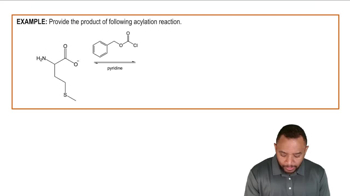
Acylation is a chemical reaction where an acyl group is introduced into a molecule. In this case, excess acetic anhydride (Ac2O) is used to acylate proline, modifying its amino group. This reaction is important for altering the properties of amino acids and can lead to the formation of N-acyl derivatives, which are key intermediates in organic synthesis.
Video consigliato:
Percorso guidato
1:01
Reactions of Amino Acids: Acylation Example 1

Enzymatic Hydrolysis

Enzymatic hydrolysis involves the breakdown of compounds through the action of enzymes, in this case, hog kidney acylase. This enzyme catalyzes the hydrolysis of the acylated proline, regenerating the amino acid and releasing acetic acid. Understanding this process is essential for predicting the final products of the reaction sequence involving proline and acetic anhydride.
Video consigliato:
Percorso guidato
3:09
Triacylglycerol Reactions: Hydrolysis Concept 3