Ch. 24 - Amino Acids, Peptides, and Proteins
Wade - Organic Chemistry 9th Edition
Wade9th EditionOrganic ChemistryISBN: 9780135213728Non è quello che usi tu?Cambia libro di testo
Capitolo 24, Problema 30b

Show how you would synthesize any of the standard amino acids from each starting material. You may use any necessary reagents.
(b)

Guida verificata passo dopo passo
1
Step 1: Analyze the starting material. The given compound is isobutyric acid (2-methylpropanoic acid), which contains a carboxylic acid functional group. This will serve as the precursor for the amino acid synthesis.
Step 2: Convert the carboxylic acid group into an α-bromo acid. Use bromine (Br2) and phosphorus tribromide (PBr3) in the presence of a solvent like acetic acid to perform the Hell-Volhard-Zelinsky reaction. This introduces a bromine atom at the α-carbon adjacent to the carboxylic acid group.
Step 3: Replace the bromine atom with an amino group (-NH2). Treat the α-bromo acid with excess ammonia (NH3) in a solvent like ethanol or water. This substitution reaction yields the corresponding α-amino acid.
Step 4: Purify the product. The resulting compound is an amino acid, specifically valine, which has both an amino group and a carboxylic acid group. Purify the product using recrystallization or other appropriate techniques.
Step 5: Verify the structure of the synthesized amino acid. Use spectroscopic methods such as NMR (nuclear magnetic resonance) and IR (infrared spectroscopy) to confirm the presence of the amino group and carboxylic acid group, ensuring the synthesis was successful.

Risposta video verificata per un problema simile:

Questa soluzione video è stata consigliata dai nostri tutor come utile per risolvere questo problema.
Durata del video:
2m

Concetti chiave

Ecco i concetti essenziali che devi comprendere per rispondere correttamente alla domanda.

Amino Acid Structure

Amino acids are organic compounds characterized by a central carbon atom bonded to an amino group (-NH2), a carboxyl group (-COOH), a hydrogen atom, and a variable side chain (R group). The R group determines the specific properties and identity of the amino acid, influencing its role in protein synthesis and function.
Video consigliato:
7:19
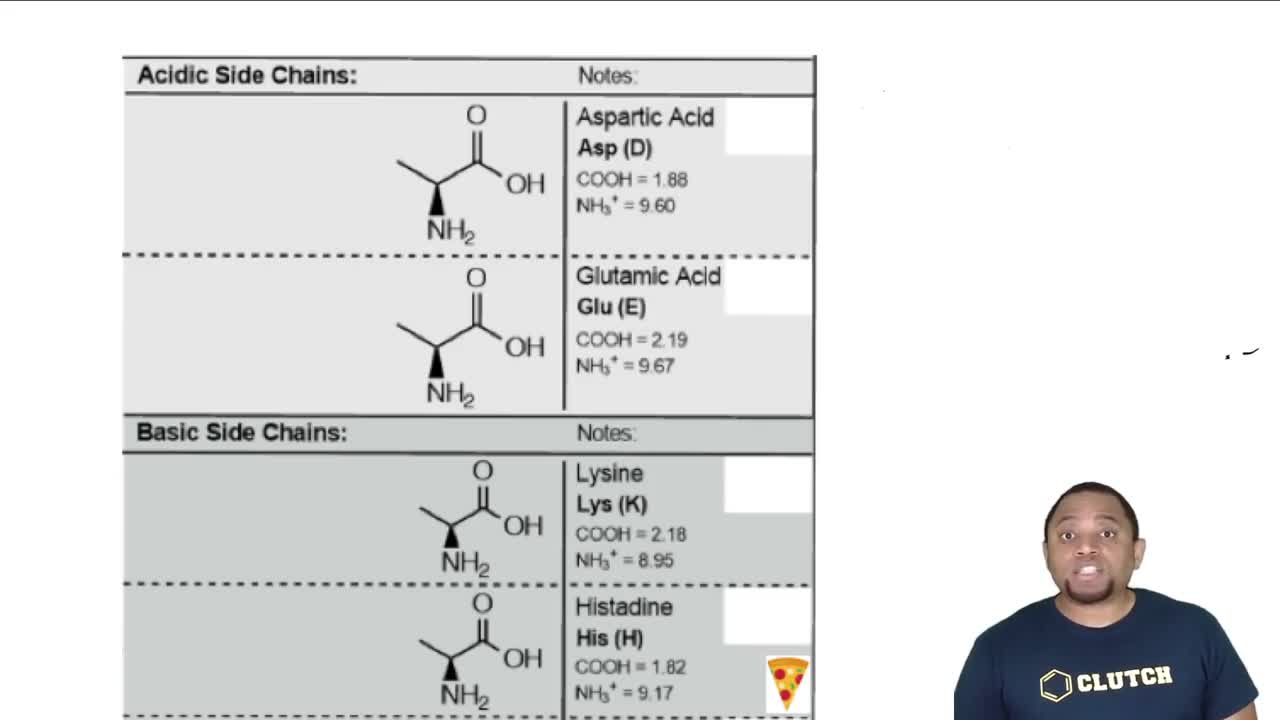
Charged Amino Acids

Synthesis of Amino Acids

The synthesis of amino acids often involves the formation of the amino and carboxyl functional groups from suitable starting materials. Common methods include the Strecker synthesis, which uses aldehydes, ammonium chloride, and cyanide, and the Gabriel synthesis, which employs phthalimide and alkyl halides to introduce the amino group.
Video consigliato:
Percorso guidato
1:16
Synthesis of Amino Acids: Strecker Synthesis Example 1

Reagents in Organic Synthesis

Reagents are substances used in chemical reactions to facilitate the transformation of reactants into products. In amino acid synthesis, reagents such as acids, bases, and coupling agents are crucial for forming peptide bonds and modifying functional groups, enabling the construction of the amino acid structure from simpler precursors.
Video consigliato:
Percorso guidato
1:16
Synthesis of Amino Acids: Strecker Synthesis Example 1