Ch. 24 - Amino Acids, Peptides, and Proteins
Wade - Organic Chemistry 9th Edition
Wade9th EditionOrganic ChemistryISBN: 9780135213728Non è quello che usi tu?Cambia libro di testo
Capitolo 24, Problema 10b

Show how you would use bromination followed by amination to synthesize the following amino acids.
(b) leucine

Guida verificata passo dopo passo
1
Identify the starting material: Leucine is a branched-chain amino acid. To synthesize leucine, we need to start with a suitable alkane or alkyl group that can be functionalized to introduce both the amino group (-NH2) and the carboxylic acid group (-COOH). A good starting material could be isocaproic acid (a branched alkane with a carboxylic acid group).
Perform bromination: Bromination is typically carried out using Br2 in the presence of light or a radical initiator. This step introduces a bromine atom to the alkane chain via a free radical halogenation mechanism. For example, brominate the isocaproic acid at the appropriate carbon to create a bromo intermediate.
Prepare for amination: The brominated intermediate can now undergo nucleophilic substitution. The bromine atom is a good leaving group, and it can be replaced by an amino group (-NH2) using an excess of ammonia (NH3) in a solvent like ethanol. This step introduces the amino group to the molecule.
Adjust the stereochemistry: If the synthesis requires a specific stereochemistry (e.g., the L-isomer of leucine), you may need to use a chiral auxiliary or resolve the racemic mixture formed during the amination step.
Finalize the structure: Ensure that the molecule has both the amino group (-NH2) and the carboxylic acid group (-COOH) in the correct positions to match the structure of leucine. If necessary, perform any additional functional group modifications or purifications to obtain the desired amino acid.

Risposta video verificata per un problema simile:

Questa soluzione video è stata consigliata dai nostri tutor come utile per risolvere questo problema.
Durata del video:
2m

Concetti chiave

Ecco i concetti essenziali che devi comprendere per rispondere correttamente alla domanda.

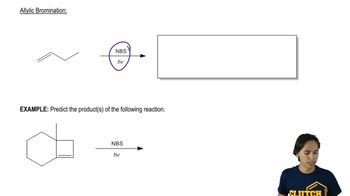
Bromination

Bromination is a chemical reaction that involves the addition of bromine to a compound, typically an alkene or an aromatic ring. This process can introduce bromine atoms into organic molecules, which can later be substituted or transformed into other functional groups. In the context of amino acid synthesis, bromination can serve as a key step to modify a precursor compound, making it more reactive for subsequent reactions.
Video consigliato:
00:54
Mechanism of Allylic Bromination.

Amination

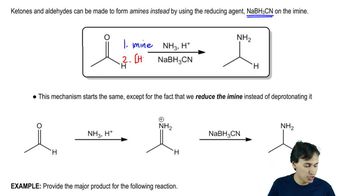
Amination refers to the process of introducing an amino group (-NH2) into a molecule. This reaction is crucial in organic synthesis, particularly for the formation of amino acids, as it allows for the conversion of halogenated compounds (like those produced by bromination) into amines. The choice of amination method can influence the final structure and properties of the synthesized amino acid, such as leucine.
Video consigliato:
07:12
Reductive Amination

Synthesis of Amino Acids

The synthesis of amino acids involves a series of chemical reactions that transform simple organic compounds into more complex structures containing both amine and carboxylic acid functional groups. Understanding the specific pathways and reactions, such as bromination followed by amination, is essential for creating amino acids like leucine. This process often requires knowledge of stereochemistry and functional group transformations to ensure the correct amino acid is produced.
Video consigliato:
Percorso guidato
1:16
Synthesis of Amino Acids: Strecker Synthesis Example 1