
Ch.3 - Structure and Stereochemistry of Alkanes
Wade - Organic Chemistry 9th Edition
Wade9th EditionOrganic ChemistryISBN: 9780135213728Non è quello che usi tu?Cambia libro di testo
Capitolo 3, Problema 48c,d

Convert each Newman projection to the equivalent line–angle formula, and assign the IUPAC name.
(c)
(d)

Guida verificata passo dopo passo
1
Step 1: Analyze the Newman projection for part c. The front carbon (circle) has substituents Br, H, and CH3. The back carbon (behind the circle) has substituents CH2CH3, H, and H. Identify the spatial arrangement of these groups to determine the connectivity.
Step 2: Convert the Newman projection for part c into a line-angle formula. The front carbon is bonded to Br, H, and CH3, while the back carbon is bonded to CH2CH3 and two H atoms. Draw the structure with the correct bond angles and connectivity.
Step 3: Assign the IUPAC name for part c. Identify the longest carbon chain, determine the substituents, and assign locants based on priority rules (e.g., halogens and alkyl groups). Ensure the name reflects the correct stereochemistry if applicable.
Step 4: Analyze the Newman projection for part d. The front carbon (circle) has substituents CH2CH3, H, and Cl. The back carbon (behind the circle) has substituents CH(CH3)2, H, and CH3. Identify the spatial arrangement of these groups to determine the connectivity.
Step 5: Convert the Newman projection for part d into a line-angle formula. The front carbon is bonded to CH2CH3, H, and Cl, while the back carbon is bonded to CH(CH3)2, H, and CH3. Draw the structure with the correct bond angles and connectivity, and assign the IUPAC name using the same process as in part c.

Risposta video verificata per un problema simile:

Questa soluzione video è stata consigliata dai nostri tutor come utile per risolvere questo problema.
Durata del video:
7m

Concetti chiave

Ecco i concetti essenziali che devi comprendere per rispondere correttamente alla domanda.

Newman Projections

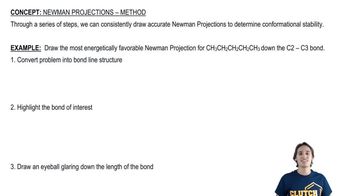
Newman projections are a way to visualize the conformation of a molecule by looking straight down the bond connecting two carbon atoms. This representation helps in understanding the spatial arrangement of substituents around the bond, which is crucial for analyzing steric interactions and torsional strain in organic compounds.
Video consigliato:
00:34
Introduction to Drawing Newman Projections

Line-Angle Formulas

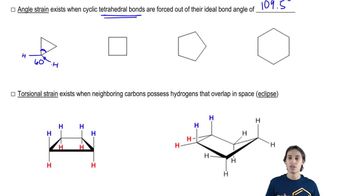
Line-angle formulas, also known as skeletal structures, are a shorthand way of representing organic molecules. In this format, vertices represent carbon atoms, and lines represent bonds, making it easier to visualize complex structures without explicitly drawing every atom. This method is particularly useful for quickly conveying the structure of larger organic molecules.
Video consigliato:
02:46
What is angle strain?

IUPAC Nomenclature

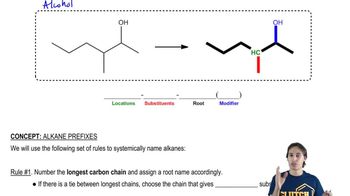
IUPAC nomenclature is a systematic method for naming organic chemical compounds. It provides rules for constructing names based on the structure of the molecule, including the longest carbon chain, functional groups, and substituents. Understanding these rules is essential for accurately identifying and communicating the identity of organic compounds.
Video consigliato:
03:43
The different parts of an IUPAC name