Ch.3 - Structure and Stereochemistry of Alkanes
Wade - Organic Chemistry 9th Edition
Wade9th EditionOrganic ChemistryISBN: 9780135213728Non è quello che usi tu?Cambia libro di testo
Capitolo 3, Problema 16e,f

Draw the structure and give the molecular formula for each of the following compounds.
e. 3-ethyl-2,4-dimethylhexane
f. 1,1-diethyl-4-(3,3-dimethylbutyl)cyclohexane

Guida verificata passo dopo passo
1
Step 1: Begin with the compound 3-ethyl-2,4-dimethylhexane. Identify the parent chain, which is hexane, indicating a six-carbon chain. Number the chain from one end to the other to ensure the substituents get the lowest possible numbers.
Step 2: Add the substituents to the hexane chain. At carbon 3, attach an ethyl group (C₂H₅). At carbons 2 and 4, attach methyl groups (CH₃). Ensure the structure reflects the correct positions of these groups.
Step 3: Count all the carbon and hydrogen atoms in the structure to determine the molecular formula for 3-ethyl-2,4-dimethylhexane. Combine the number of carbons and hydrogens from the parent chain and substituents.
Step 4: For 1,1-diethyl-4-(3,3-dimethylbutyl)cyclohexane, start with the cyclohexane ring, which consists of six carbon atoms arranged in a ring. Number the ring to give the substituents the lowest possible numbers.
Step 5: Attach the substituents to the cyclohexane ring. At carbon 1, add two ethyl groups (C₂H₅). At carbon 4, attach a 3,3-dimethylbutyl group, which is a butyl chain with two methyl groups at the third carbon. Count all the carbon and hydrogen atoms to determine the molecular formula.

Risposta video verificata per un problema simile:

Questa soluzione video è stata consigliata dai nostri tutor come utile per risolvere questo problema.
Durata del video:
6m

Concetti chiave

Ecco i concetti essenziali che devi comprendere per rispondere correttamente alla domanda.

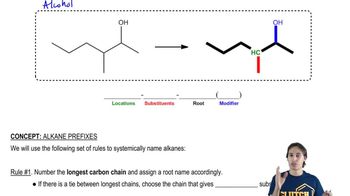
IUPAC Nomenclature

IUPAC nomenclature is a systematic method of naming organic chemical compounds as recommended by the International Union of Pure and Applied Chemistry. It provides a standardized way to name compounds based on their structure, ensuring clarity and consistency. Understanding IUPAC rules is essential for interpreting and constructing chemical names, such as identifying the longest carbon chain and the position of substituents.
Video consigliato:
03:43
The different parts of an IUPAC name

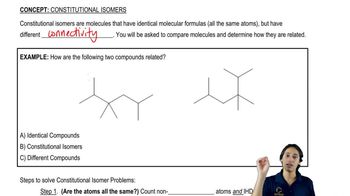
Structural Isomers

Structural isomers are compounds with the same molecular formula but different structural arrangements of atoms. This concept is crucial for drawing the correct structure of a compound, as different arrangements can lead to different chemical properties. Recognizing structural isomers involves understanding how atoms can be connected differently while maintaining the same overall formula.
Video consigliato:
01:10
What is a constitutional isomer?

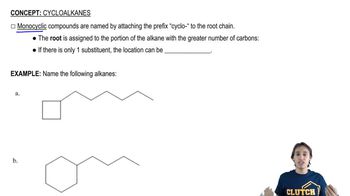
Cycloalkanes

Cycloalkanes are a type of hydrocarbon with carbon atoms arranged in a ring structure. They differ from alkanes, which have linear or branched chains. Understanding cycloalkanes involves recognizing the ring structure and how substituents are attached to the ring, which affects the compound's chemical behavior and naming. Cyclohexane, for example, is a common cycloalkane with six carbon atoms forming a ring.
Video consigliato:
01:11
How to find the root name for cycloalkanes