Ch.3 - Structure and Stereochemistry of Alkanes
Wade - Organic Chemistry 9th Edition
Wade9th EditionOrganic ChemistryISBN: 9780135213728Non è quello che usi tu?Cambia libro di testo
Capitolo 3, Problema 36e,f

Draw the structure that corresponds with each name.
e. 2,2,4,4-tetramethylhexane
f. trans-1,3-diethylcyclopentane

Guida verificata passo dopo passo
1
To draw 2,2,4,4-tetramethylhexane, start by identifying the parent chain. The parent chain is 'hexane', which means it has 6 carbon atoms in a straight chain.
Next, identify the substituents. The name '2,2,4,4-tetramethyl' indicates that there are four methyl groups attached to the parent chain. Two methyl groups are attached to carbon 2, and two are attached to carbon 4.
Draw the hexane chain by arranging six carbon atoms in a linear sequence. Then, add the methyl groups: two on the second carbon and two on the fourth carbon.
For trans-1,3-diethylcyclopentane, start by drawing the cyclopentane ring, which is a five-membered carbon ring.
Identify the substituents: '1,3-diethyl' means there are ethyl groups attached to carbons 1 and 3. The 'trans' configuration indicates that these ethyl groups are on opposite sides of the cyclopentane ring. Draw the ethyl groups accordingly, ensuring they are on opposite sides of the plane of the ring.

Risposta video verificata per un problema simile:

Questa soluzione video è stata consigliata dai nostri tutor come utile per risolvere questo problema.
Durata del video:
5m

Concetti chiave

Ecco i concetti essenziali che devi comprendere per rispondere correttamente alla domanda.

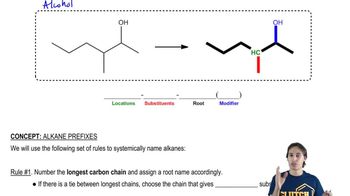
IUPAC Nomenclature

IUPAC nomenclature is a standardized system for naming chemical compounds. It involves identifying the longest carbon chain, numbering the chain to give substituents the lowest possible numbers, and naming substituents as prefixes. Understanding this system is crucial for interpreting and drawing structures from chemical names.
Video consigliato:
03:43
The different parts of an IUPAC name

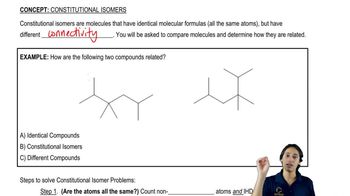
Structural Isomers

Structural isomers are compounds with the same molecular formula but different structural arrangements. In organic chemistry, recognizing how substituents can be arranged differently on a carbon skeleton is essential for drawing accurate structures, as seen in compounds like 2,2,4,4-tetramethylhexane.
Video consigliato:
01:10
What is a constitutional isomer?

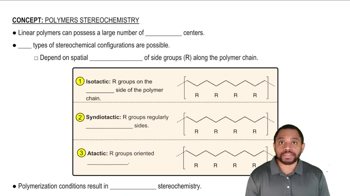
Stereochemistry

Stereochemistry involves the study of spatial arrangement of atoms in molecules. Terms like 'trans' indicate specific geometric configurations, where substituents are on opposite sides of a ring or double bond. Understanding stereochemistry is vital for accurately depicting molecules like trans-1,3-diethylcyclopentane.
Video consigliato:
Percorso guidato
1:38
Polymer Stereochemistry Concept 1