Ch.4 - The Study of Chemical Reactions
Wade - Organic Chemistry 9th Edition
Wade9th EditionOrganic ChemistryISBN: 9780135213728Non è quello che usi tu?Cambia libro di testo
Capitolo 4, Problema 2a

Write the propagation steps leading to the formation of dichloromethane (CH2Cl2) from chloromethane.

Guida verificata passo dopo passo
1
Step 1: Understand the context of the problem. This is a free radical halogenation reaction involving chloromethane (CH3Cl) and chlorine (Cl2). The propagation steps are part of the chain reaction mechanism where radicals are involved.
Step 2: Write the first propagation step. A chlorine radical (Cl•) reacts with chloromethane (CH3Cl), abstracting a hydrogen atom to form a methyl radical (•CH2Cl) and HCl. The reaction can be represented as: Cl• + CH3Cl → •CH2Cl + HCl.
Step 3: Write the second propagation step. The methyl radical (•CH2Cl) reacts with a chlorine molecule (Cl2), forming dichloromethane (CH2Cl2) and regenerating a chlorine radical (Cl•). The reaction can be represented as: •CH2Cl + Cl2 → CH2Cl2 + Cl•.
Step 4: Recognize that these propagation steps are part of a chain reaction. The chlorine radical generated in the second step can go on to react with another molecule of chloromethane, continuing the cycle.
Step 5: Ensure the overall reaction mechanism is balanced and consistent with the principles of radical halogenation. The propagation steps demonstrate how dichloromethane is formed through successive reactions involving radicals.

Risposta video verificata per un problema simile:

Questa soluzione video è stata consigliata dai nostri tutor come utile per risolvere questo problema.
Durata del video:
1m

Concetti chiave

Ecco i concetti essenziali che devi comprendere per rispondere correttamente alla domanda.

Free Radical Halogenation

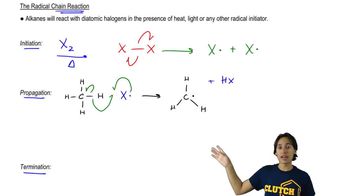
Free radical halogenation is a reaction mechanism where alkanes react with halogens (like Cl2) in the presence of heat or light to form alkyl halides. This process involves the generation of free radicals, which are highly reactive species with unpaired electrons. The reaction proceeds through three main steps: initiation, propagation, and termination, with the propagation steps being crucial for the formation of products like dichloromethane.
Video consigliato:
12:11
Radical Chain Reaction Mechanism.

Propagation Steps

Propagation steps in a free radical reaction are the stages where the free radicals react with the substrate to form new radicals and products. In the case of chloromethane to dichloromethane, the chlorine radical abstracts a hydrogen atom from chloromethane, forming dichloromethane and generating a new methyl radical, which can further react with another chlorine molecule. This cycle continues until termination occurs.
Video consigliato:
Percorso guidato
1:05
Step-Growth Polymers Concept 1

Selectivity in Halogenation

Selectivity in halogenation refers to the preference of a halogen to react with certain hydrogen atoms over others in a molecule. In the case of chloromethane, the chlorine radical can abstract hydrogen from the methyl group, leading to the formation of dichloromethane. The selectivity is influenced by factors such as the stability of the resulting radicals and the bond dissociation energies of the C-H bonds.
Video consigliato:
03:45
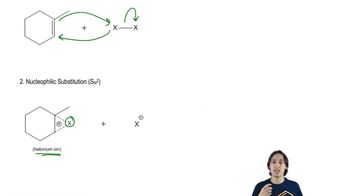
Halogenation Mechanism