
Ch.4 - The Study of Chemical Reactions
Wade - Organic Chemistry 9th Edition
Wade9th EditionOrganic ChemistryISBN: 9780135213728Non è quello che usi tu?Cambia libro di testo
Capitolo 4, Problema 4

The bromination of methane proceeds through the following steps: 1. Br2 + 2 Br• ΔH° (per mole)/+190 kJ (45 kcal) Ea (per mole)/ 190 kJ (45 kcal) 2. CH4 + Br• —> CH3+ HBr +73 kJ (17 kcal) 79 kJ (19 kcal) 3. • CH3 + Br2 —> CH3Br + Br -112 kJ (-27 kcal) 4 kJ (1 kcal) a. Draw a complete reaction-energy diagram for this reaction. b. Label the rate-limiting step.

Guida verificata passo dopo passo
1
Identify the steps involved in the bromination of methane: initiation, propagation, and termination.
For the reaction-energy diagram, plot the energy on the y-axis and the reaction progress on the x-axis.
Start with the energy level of the reactants (Br2 and CH4) and show the energy change for each step.
Indicate the energy barrier (activation energy, Ea) for each step, especially focusing on the highest energy transition state.
Label the rate-limiting step as the one with the highest activation energy, which is typically the slowest step in the reaction.

Risposta video verificata per un problema simile:

Questa soluzione video è stata consigliata dai nostri tutor come utile per risolvere questo problema.
Durata del video:
13m

Concetti chiave

Ecco i concetti essenziali che devi comprendere per rispondere correttamente alla domanda.

Reaction Energy Diagram

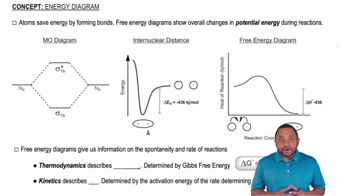
A reaction energy diagram visually represents the energy changes during a chemical reaction. It typically plots the energy of the reactants, products, and the transition states against the reaction coordinate. Key features include the activation energy (Ea) for each step and the overall change in enthalpy (ΔH°). Understanding this diagram is crucial for identifying the energy barriers and the stability of intermediates in the reaction.
Video consigliato:
08:30
Introduction to free energy diagrams.

Activation Energy (Ea)

Activation energy is the minimum energy required for a chemical reaction to occur. It represents the energy barrier that reactants must overcome to form products. In the context of the bromination of methane, each step has a specific Ea, which influences the rate of the reaction. The step with the highest Ea is the rate-limiting step, determining the overall speed of the reaction.
Video consigliato:
Percorso guidato
3:22
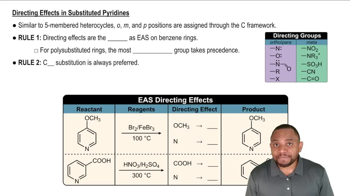
EAS Reactions of Pyridine Concept 3

Rate-Limiting Step

The rate-limiting step is the slowest step in a multi-step reaction mechanism, which dictates the overall reaction rate. It has the highest activation energy compared to other steps, meaning it takes the longest time to occur. Identifying this step is essential for understanding the kinetics of the reaction and for predicting how changes in conditions might affect the reaction rate.
Video consigliato:
10:14
Limitations
Pratica correlata
Domanda del libro di testo

Use the bond-dissociation enthalpies in Table 4-2 (page 167) to calculate the heats of reaction for the two possible first propagation steps in the chlorination of isobutane. Use this information to draw a reaction-energy diagram like Figure 4-8, comparing the activation energies for formation of the two radicals.

1047
views
Domanda del libro di testo
Deuterium (D) is the hydrogen isotope of mass number 2, with a proton and a neutron in its nucleus. The chemistry of deuterium is nearly identical to the chemistry of hydrogen, except that the C―D bond is slightly stronger than the C―H bond by 5.0 kJ/mol (1.2 kcal/ mol). Reaction rates tend to be slower when a C―D bond (as opposed to a C―H bond) is broken in a rate-limiting step. This effect, called a kinetic isotope effect, is clearly seen in the chlorination of methane. Methane undergoes free-radical chlorination 12 times as fast as tetradeuteriomethane (CD4) Faster: CH4 + Cl⋅ —> CH3Cl + HCl relative rate= 12 Slower: CD4 + Cl⋅ —> CD3Cl + DCl relative rate= 1 c. Consider the thermodynamics of the chlorination of methane and the chlorination of ethane, and use the Hammond postulate to explain why one of these reactions has a much larger isotope effect than the other.
1786
views
Domanda del libro di testo
Use bond-dissociation enthalpies [TABLE 4-2], p. 167) to calculate values of ΔH° for the following reactions. a. CH3—CH3 + I2 —> CH3CH2I + HI
1425
views
Domanda del libro di testo

Free-radical chlorination of hexane gives very poor yields of 1-chlorohexane, while cyclohexane can be converted to chlorocyclohexane in good yield.

a. How do you account for this difference?

b. What ratio of reactants (cyclohexane and chlorine) would you use for the synthesis of chlorocyclohexane?

2423
views
Domanda del libro di testo
The bromination of methane proceeds through the following steps: 1. Br2 + 2 Br• ΔH° (per mole)/+190 kJ (45 kcal) Ea (per mole)/ 190 kJ (45 kcal) 2. CH4 + Br• —> CH3+ HBr +73 kJ (17 kcal) 79 kJ (19 kcal) 3. • CH3 + Br2 —> CH3Br + Br -112 kJ (-27 kcal) 4 kJ (1 kcal) d. Compute the overall value of ΔH° for the bromination
1172
views
Domanda del libro di testo
The reaction of tert-butyl chloride with methanol (CH3)3C—Cl Tert-butylchloride + CH3—OH methanol —> (CH3)C—OCH3 methyltert-butylether + HCl is found to follow the rate equation rate= Kr[(CH3)3C—Cl] c. What is the kinetic order overall?
698
views