Ch.4 - The Study of Chemical Reactions
Wade - Organic Chemistry 9th Edition
Wade9th EditionOrganic ChemistryISBN: 9780135213728Non è quello che usi tu?Cambia libro di testo
Capitolo 4, Problema 48a

When exactly 1 mole of methane is mixed with exactly 1 mole of chlorine and light is shone on the mixture, a ­chlorination reaction occurs. The products are found to contain substantial amounts of di-, tri-, and tetrachloromethane, as well as ­unreacted methane.
a. Explain how a mixture is formed from this stoichiometric mixture of reactants, and propose mechanisms for the ­formation of these compounds from chloromethane.

Guida verificata passo dopo passo
1
Understand the reaction: The reaction between methane (CH₄) and chlorine (Cl₂) in the presence of light is a free radical substitution reaction. The light provides energy to break the Cl-Cl bond, initiating the reaction. This process is called photochemical chlorination.
Step 1: Initiation - The Cl₂ molecule absorbs light energy, causing homolytic cleavage of the Cl-Cl bond to form two chlorine radicals (Cl•). This can be represented as: Cl₂ → 2Cl•.
Step 2: Propagation - The chlorine radical reacts with methane (CH₄), abstracting a hydrogen atom to form hydrochloric acid (HCl) and a methyl radical (CH₃•). This is followed by the methyl radical reacting with another Cl₂ molecule to form chloromethane (CH₃Cl) and another chlorine radical. These steps can be written as: Cl• + CH₄ → CH₃• + HCl and CH₃• + Cl₂ → CH₃Cl + Cl•.
Step 3: Formation of higher chlorinated products - The chloromethane (CH₃Cl) formed in the propagation step can undergo further substitution reactions. The chlorine radical can abstract another hydrogen atom from CH₃Cl to form dichloromethane (CH₂Cl₂), and this process can continue to form trichloromethane (CHCl₃) and tetrachloromethane (CCl₄). Each step involves the same propagation mechanism: Cl• + CH₃Cl → CH₂Cl• + HCl, CH₂Cl• + Cl₂ → CH₂Cl₂ + Cl•, and so on.
Step 4: Termination - The reaction can terminate when two radicals combine to form a stable molecule, such as Cl• + Cl• → Cl₂ or CH₃• + Cl• → CH₃Cl. These termination steps reduce the number of radicals in the system, slowing down the reaction. The mixture of products (CH₄, CH₃Cl, CH₂Cl₂, CHCl₃, and CCl₄) arises because the reaction does not stop after the formation of CH₃Cl, and further substitutions occur due to the presence of excess chlorine radicals.

Risposta video verificata per un problema simile:

Questa soluzione video è stata consigliata dai nostri tutor come utile per risolvere questo problema.
Durata del video:
13m

Concetti chiave

Ecco i concetti essenziali che devi comprendere per rispondere correttamente alla domanda.

Stoichiometry

Stoichiometry is the calculation of reactants and products in chemical reactions based on the conservation of mass. In this context, it refers to the precise mixing of 1 mole of methane and 1 mole of chlorine, which allows for the prediction of the amounts of products formed. Understanding stoichiometry is essential for analyzing how reactants interact and the ratios in which they combine to form various chlorinated methane products.
Video consigliato:
02:08
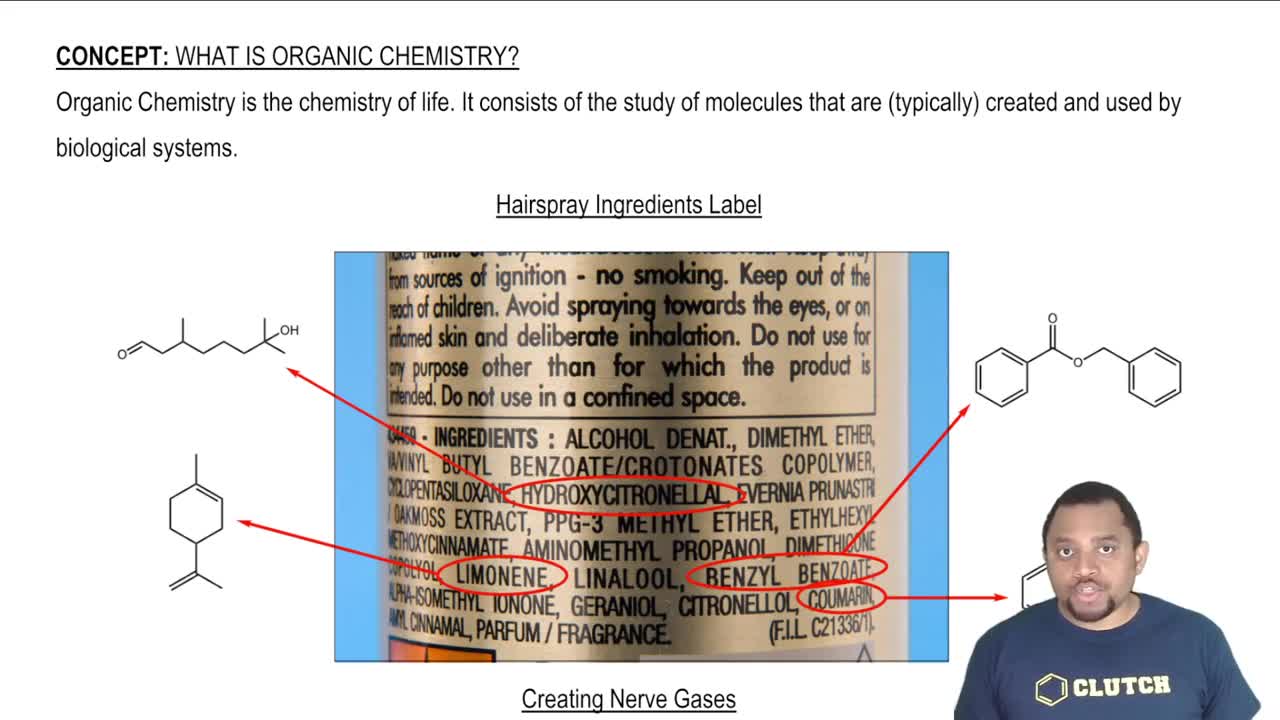
Organic molecules in your everyday life.

Free Radical Mechanism

The chlorination of methane occurs via a free radical mechanism, which involves the formation of reactive intermediates called free radicals. When light is shone on the mixture, it initiates the reaction by breaking the Cl-Cl bond, generating chlorine radicals. These radicals then react with methane to form chloromethane and further react to produce di-, tri-, and tetrachloromethane through successive substitution reactions.
Video consigliato:
03:28
The mechanism of Radical Polymerization.

Substitution Reactions

Substitution reactions involve the replacement of one atom or group in a molecule with another atom or group. In the case of chlorination, chlorine atoms replace hydrogen atoms in methane, leading to the formation of chlorinated products. The reaction can proceed through multiple steps, resulting in various chlorinated compounds, such as dichloromethane, trichloromethane, and tetrachloromethane, depending on the number of substitutions that occur.
Video consigliato:
01:34
Recognizing Substitution Reactions.
Pratica correlata
Domanda del libro di testo

For each compound, predict the major product of free-radical bromination. Remember that bromination is highly selective, and only the most stable radical will be formed.

(e)

1449
views

Domanda del libro di testo

The chlorination of pentane gives a mixture of three monochlorinated products.

b. Predict the ratios in which these monochlorination products will be formed, remembering that a chlorine atom abstracts a secondary hydrogen about 4.5 times as fast as it abstracts a primary hydrogen.

1908
views
Domanda del libro di testo

For each compound, predict the major product of free-radical bromination. Remember that bromination is highly selective, and only the most stable radical will be formed.

(a) cyclohexane

(b) methylcyclopentane

2161
views
Domanda del libro di testo

The chlorination of pentane gives a mixture of three monochlorinated products.

a. Draw their structures.

2466
views
Domanda del libro di testo

For each compound, predict the major product of free-radical bromination. Remember that bromination is highly selective, and only the most stable radical will be formed.

(f)

788
views
Domanda del libro di testo

When exactly 1 mole of methane is mixed with exactly 1 mole of chlorine and light is shone on the mixture, a ­chlorination reaction occurs. The products are found to contain substantial amounts of di-, tri-, and tetrachloromethane, as well as ­unreacted methane.

b. How would you run this reaction to get a good conversion of methane to CH3Cl? Of methane to CCl4?

841
views