Ch.4 - The Study of Chemical Reactions
Wade - Organic Chemistry 9th Edition
Wade9th EditionOrganic ChemistryISBN: 9780135213728Non è quello che usi tu?Cambia libro di testo
Capitolo 4, Problema 56

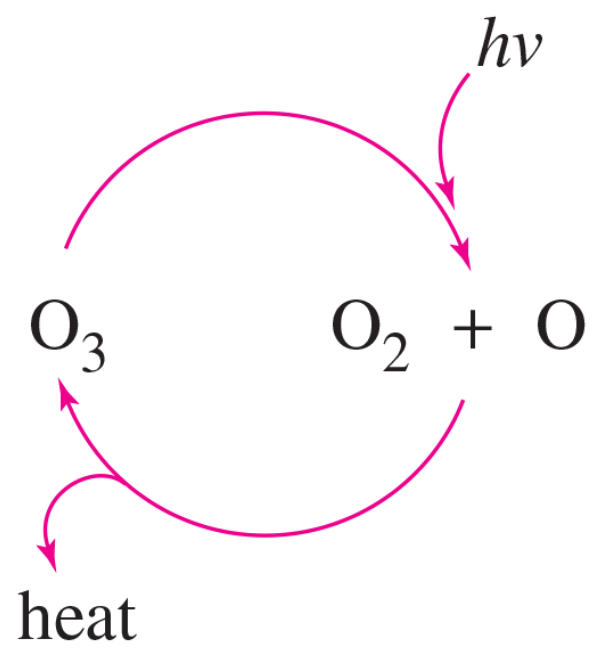
When healthy, Earth’s stratosphere contains a low concentration of ozone (O3) that absorbs potentially harmful ­ultraviolet (UV) radiation by the cycle shown at right.
Chlorofluorocarbon refrigerants, such as Freon 12 (CF2Cl2), are stable in the lower atmosphere, but in the stratosphere they absorb high-energy UV radiation to generate chlorine radicals.


The presence of a small number of chlorine radicals appears to lower ozone concentrations dramatically. The following reactions are all known to be exothermic (except the one requiring light) and to have high rate constants. Propose two mechanisms to explain how a small number of chlorine ­radicals can destroy large numbers of ozone molecules. Which of the two mechanisms is more likely when the concentration of chlorine atoms is very small?

Guida verificata passo dopo passo
1
Step 1: Understand the problem. The question involves the destruction of ozone (O3) in the stratosphere by chlorine radicals (Cl⋅) generated from chlorofluorocarbons (CFCs). The goal is to propose two mechanisms that explain how a small number of chlorine radicals can destroy a large number of ozone molecules and determine which mechanism is more likely when the concentration of chlorine atoms is very small.
Step 2: Analyze the given reactions. The reactions provided show how chlorine radicals interact with ozone and other species in the stratosphere. Key reactions include: (1) Cl⋅ + O3 → Cl—O⋅ + O2, (2) Cl—O⋅ + O → Cl⋅ + O2, and (3) 2 Cl—O⋅ → Cl—O—O—Cl. These reactions suggest a catalytic cycle where chlorine radicals are regenerated, allowing them to destroy multiple ozone molecules.
Step 3: Propose Mechanism 1. In this mechanism, chlorine radicals (Cl⋅) act as a catalyst in a two-step cycle: (1) Cl⋅ reacts with ozone (O3) to form Cl—O⋅ and O2, and (2) Cl—O⋅ reacts with an oxygen atom (O) to regenerate Cl⋅ and produce another O2 molecule. This cycle can repeat, allowing a single Cl⋅ to destroy multiple ozone molecules.
Step 4: Propose Mechanism 2. In this mechanism, chlorine radicals form a dimer intermediate (Cl—O—O—Cl) through the reaction 2 Cl—O⋅ → Cl—O—O—Cl. This dimer can then decompose under UV light (hv) to regenerate 2 Cl⋅ and release O2. The regenerated Cl⋅ can then continue to destroy ozone molecules, making this another catalytic cycle.
Step 5: Determine the more likely mechanism at low chlorine concentrations. Mechanism 1 is more likely when the concentration of chlorine atoms is very small because it involves a simple two-step cycle that does not require the formation of a dimer intermediate. Mechanism 2, which involves the formation of Cl—O—O—Cl, is less likely at low concentrations due to the lower probability of two Cl—O⋅ radicals colliding to form the dimer.

Risposta video verificata per un problema simile:

Questa soluzione video è stata consigliata dai nostri tutor come utile per risolvere questo problema.
Durata del video:
7m

Concetti chiave

Ecco i concetti essenziali che devi comprendere per rispondere correttamente alla domanda.

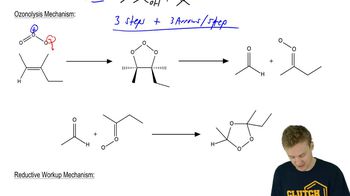
Ozone Depletion Mechanism

Ozone depletion occurs when ozone (O3) molecules are broken down by reactive species, such as chlorine radicals (Cl·). These radicals can initiate a chain reaction, where one chlorine atom can destroy thousands of ozone molecules. Understanding this mechanism is crucial for analyzing how a small concentration of chlorine can lead to significant ozone loss in the stratosphere.
Video consigliato:
07:48
General Mechanism:

Exothermic Reactions

Exothermic reactions release energy, often in the form of heat, during the process of breaking and forming chemical bonds. In the context of ozone depletion, the reactions involving chlorine radicals and ozone are exothermic, which means they can proceed rapidly and contribute to the efficiency of ozone destruction. Recognizing the nature of these reactions helps in understanding their impact on atmospheric chemistry.
Video consigliato:
05:09
Heck Reaction

Chain Reactions

Chain reactions are processes where the products of a reaction initiate further reactions, leading to a rapid increase in the number of reactants consumed. In the case of chlorine radicals and ozone, one chlorine radical can react with an ozone molecule to produce more radicals, perpetuating the cycle. This concept is essential for explaining why even a small number of chlorine radicals can have a large effect on ozone concentrations.
Video consigliato:
Percorso guidato
1:57
Side-Chain Reactions of Substituted Pyridines Example 3
Pratica correlata
Domanda del libro di testo

When ethene is treated in a calorimeter with H2 and a Pt catalyst, the heat of reaction is found to be –137 kJ/mol (–32.7 kcal/mol), and the reaction goes to completion. When the reaction takes place at 1400 K, the equilibrium is found to be evenly balanced, with Keq =1.  Compute the value of ΔS for this reaction.

934
views
Domanda del libro di testo

Tributyltin hydride (Bu3SnH) is used synthetically to reduce alkyl halides, replacing a halogen atom with hydrogen. ­Free-radical initiators promote this reaction, and free-radical inhibitors are known to slow or stop it. Your job is to develop a mechanism, using the following reaction as the example.

The following bond-dissociation enthalpies may be helpful: 

b. Calculate values of ΔH for your proposed steps to show that they are energetically feasible. (Hint: A trace of Br2 and light suggests it’s there only as an initiator, to create Br• radicals. Then decide which atom can be abstracted most favorably from the starting materials by the Br• radical. That should complete the initiation. Finally, decide what energetically favored propagation steps will accomplish the reaction.)

1777
views
Domanda del libro di testo

When a small amount of iodine is added to a mixture of chlorine and methane, it prevents chlorination from occurring. Therefore, iodine is a free-radical inhibitor for this reaction. Calculate ΔH° values for the possible reactions of iodine with species present in the chlorination of methane, and use these values to explain why iodine inhibits the reaction. (The I―Cl bond-dissociation enthalpy is 211 kJ/mol or 50 kcal/mol.)

1081
views
Domanda del libro di testo

Deuterium (D) is the hydrogen isotope of mass number 2, with a proton and a neutron in its nucleus. The chemistry of deuterium is nearly identical to the chemistry of hydrogen, except that the C―D bond is slightly stronger than the C―H bond by 5.0 kJ/mol (1.2 kcal/ mol). Reaction rates tend to be slower when a C―D bond (as opposed to a C―H bond) is broken in a rate-limiting step.

This effect, called a kinetic isotope effect, is clearly seen in the chlorination of methane. Methane undergoes free-radical chlorination 12 times as fast as tetradeuteriomethane (CD4).

c. Consider the thermodynamics of the chlorination of methane and the chlorination of ethane, and use the Hammond postulate to explain why one of these reactions has a much larger isotope effect than the other.

1369
views
Domanda del libro di testo

Deuterium (D) is the hydrogen isotope of mass number 2, with a proton and a neutron in its nucleus. The chemistry of deuterium is nearly identical to the chemistry of hydrogen, except that the C―D bond is slightly stronger than the C―H bond by 5.0 kJ/mol (1.2 kcal/mol). Reaction rates tend to be slower when a C―D bond (as opposed to a C―H bond) is broken in a rate-limiting step.

This effect, called a kinetic isotope effect, is clearly seen in the chlorination of methane. Methane undergoes free-radical chlorination 12 times as fast as tetradeuteriomethane (CD4).

a. Draw the transition state for the rate-limiting step of each of these reactions, showing how a bond to hydrogen or ­deuterium is being broken in this step.

835
views
Domanda del libro di testo

Deuterium (D) is the hydrogen isotope of mass number 2, with a proton and a neutron in its nucleus. The chemistry of deuterium is nearly identical to the chemistry of hydrogen, except that the C―D bond is slightly stronger than the C―H bond by 5.0 kJ/mol (1.2 kcal/mol). Reaction rates tend to be slower when a C―D bond (as opposed to a C―H bond) is broken in a rate-limiting step.

This effect, called a kinetic isotope effect, is clearly seen in the chlorination of methane. Methane undergoes free-radical chlorination 12 times as fast as tetradeuteriomethane (CD4).

b. Monochlorination of deuterioethane (C2H5D) leads to a mixture containing 93% C2H4DCl and 7% C2H5Cl. Calculate the relative rates of abstraction per hydrogen and deuterium in the chlorination of deuterioethane.

734
views