
Ch.4 - The Study of Chemical Reactions
Wade - Organic Chemistry 9th Edition
Wade9th EditionOrganic ChemistryISBN: 9780135213728Non è quello che usi tu?Cambia libro di testo
Capitolo 4, Problema 33

When it is strongly heated, ethyl diazoacetate decomposes to give nitrogen gas and a carbene. Draw a Lewis structure of the carbene.

Guida verificata passo dopo passo
1
Identify the structure of ethyl diazoacetate from the image. It consists of a diazo group (N2) attached to a carbon, which is also connected to an ester group.
Understand that upon heating, ethyl diazoacetate decomposes to release nitrogen gas (N2), leaving behind a carbene. The diazo group is responsible for this decomposition.
Focus on the carbon atom that is directly attached to the diazo group. This carbon will become the carbene after the nitrogen gas is released.
Draw the Lewis structure of the carbene. A carbene is a neutral species with a divalent carbon atom that has two non-bonded electrons. Represent the carbon with two single bonds and a pair of dots indicating the lone pair of electrons.
Ensure that the carbene carbon is shown with only six electrons in its valence shell, reflecting its divalent nature. This includes the two electrons from the lone pair and the electrons from the two single bonds.

Risposta video verificata per un problema simile:

Questa soluzione video è stata consigliata dai nostri tutor come utile per risolvere questo problema.
Durata del video:
4m

Concetti chiave

Ecco i concetti essenziali che devi comprendere per rispondere correttamente alla domanda.

Carbene

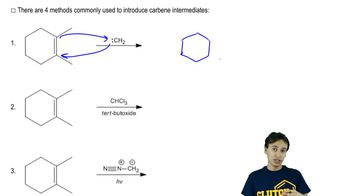
A carbene is a reactive intermediate in organic chemistry characterized by a carbon atom with only six valence electrons, resulting in a divalent state. This species typically has a neutral charge and can exist in two forms: singlet (with paired electrons) and triplet (with unpaired electrons). Carbenes are highly reactive and can participate in various chemical reactions, including insertion into C-H bonds and cyclopropanation.
Video consigliato:
01:48
Reaction with a simple carbene.

Decomposition Reaction

A decomposition reaction is a type of chemical reaction where a single compound breaks down into two or more simpler products. In the case of ethyl diazoacetate, heating causes it to decompose into nitrogen gas and a carbene. This process is often endothermic and can be driven by heat, light, or other forms of energy, leading to the formation of reactive intermediates.
Video consigliato:
05:09
Heck Reaction

Lewis Structures

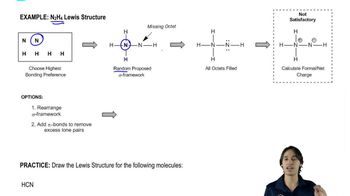
Lewis structures are diagrams that represent the bonding between atoms in a molecule and the lone pairs of electrons that may exist. They are essential for visualizing the arrangement of electrons and understanding molecular geometry. In drawing a Lewis structure for a carbene, it is crucial to depict the carbon atom with a double bond to another atom and two unshared electrons, illustrating its unique electronic configuration.
Video consigliato:
04:12
Drawing the Lewis Structure for N2H4.
Pratica correlata
Domanda del libro di testo

Consider the following reaction-energy diagram.

a. Label the reactants and the products. Label the activation energy for the first step and the second step.

b. Is the overall reaction endothermic or exothermic? What is the sign of ΔH°?

c. Which points in the curve correspond to intermediates? Which correspond to transition states?

d. Label the transition state of the rate-limiting step. Does its structure resemble the reactants, the products, or an ­intermediate?

2438
views
Domanda del libro di testo

Rank the following radicals in decreasing order of stability. Classify each as primary, secondary, or tertiary.

a. The isopentyl radical,

b. The 3-methyl-2-butyl radical,

c. The 2-methyl-2-butyl radical,

d.

1388
views
Domanda del libro di testo

The following reaction is a common synthesis used in the organic chemistry laboratory course.

When we double the concentration of methoxide ion (CH3O–), we find that the reaction rate doubles. When we triple the concentration of 1-bromobutane, we find that the reaction rate triples.

a. What is the order of this reaction with respect to 1-bromobutane? What is the order with respect to methoxide ion? Write the rate equation for this reaction. What is the overall order?

1195
views
1
rank
Domanda del libro di testo

Acetonitrile (CH3C≡N) is deprotonated by very strong bases. Write resonance forms to show the stabilization of the carbanion that results.

1994
views
Domanda del libro di testo

Draw a reaction-energy diagram for a one-step exothermic reaction. Label the parts that represent the reactants, products, transition state, activation energy, and heat of reaction.

2603
views
Domanda del libro di testo

Acetylacetone (pentane-2,4-dione) reacts with sodium hydroxide to give water and the sodium salt of a carbanion. Write a complete structural formula for the carbanion, and use resonance forms to show the stabilization of the carbanion.

3556
views