
Ch.5 - Stereochemistry
Wade - Organic Chemistry 9th Edition
Wade9th EditionOrganic ChemistryISBN: 9780135213728Non è quello che usi tu?Cambia libro di testo
Capitolo 5, Problema 38d

3,4-Dimethylpent-1-ene has the formula CH2=CH—CH(CH3)—CH(CH3)2. When pure (R)-3,4-dimethylpent-1-ene is treated with hydrogen over a platinum catalyst, the product is (S)-2,3-dimethylpentane.
d. How useful is the (R) or (S) designation for predicting the sign of an optical rotation? Can you predict the sign of the rotation of the reactant? Of the product? (Hint from Juliet Capulet: “What’s in a name? That which we call a rose/By any other name would smell as sweet.”)

Guida verificata passo dopo passo
1
Understand the context: The (R) and (S) designations refer to the absolute configuration of chiral centers in a molecule, based on the Cahn-Ingold-Prelog priority rules. These designations do not directly correlate with the sign of optical rotation (i.e., whether the compound is dextrorotatory (+) or levorotatory (-)). Optical rotation must be determined experimentally.
Analyze the reactant: The reactant, (R)-3,4-dimethylpent-1-ene, has a defined absolute configuration at its chiral center. However, the (R) designation does not provide information about whether the compound rotates plane-polarized light to the right (+) or to the left (-). Therefore, the sign of the optical rotation of the reactant cannot be predicted solely from the (R) configuration.
Analyze the product: The product, (S)-2,3-dimethylpentane, has a different absolute configuration at its chiral center compared to the reactant. However, as with the reactant, the (S) designation does not indicate the direction of optical rotation. The sign of the optical rotation of the product must also be determined experimentally.
Consider the relationship between reactant and product: The reaction involves hydrogenation over a platinum catalyst, which changes the double bond in the reactant to a single bond in the product. This process also inverts the configuration at the chiral center, converting (R) to (S). However, this inversion does not allow us to predict the optical rotation of the product based on the reactant.
Conclusion: The (R) or (S) designation is useful for describing the absolute configuration of chiral centers but is not sufficient for predicting the sign of optical rotation. The optical rotation of both the reactant and the product must be determined experimentally, as there is no direct correlation between configuration and optical activity.

Risposta video verificata per un problema simile:

Questa soluzione video è stata consigliata dai nostri tutor come utile per risolvere questo problema.
Durata del video:
3m

Concetti chiave

Ecco i concetti essenziali che devi comprendere per rispondere correttamente alla domanda.

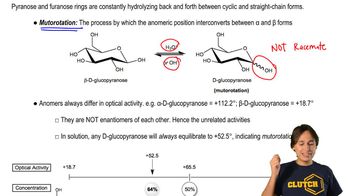
Optical Activity

Optical activity refers to the ability of chiral compounds to rotate plane-polarized light. Chiral molecules have non-superimposable mirror images, leading to two enantiomers that can rotate light in opposite directions. The direction and degree of rotation depend on the specific structure of the molecule and its concentration. Understanding optical activity is crucial for predicting the behavior of (R) and (S) enantiomers in reactions.
Video consigliato:
08:17
Mutorotation and Optical Activity

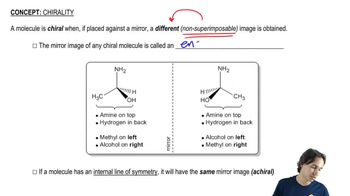
Chirality and Enantiomers

Chirality is a property of a molecule that makes it non-superimposable on its mirror image, resulting in two enantiomers with distinct spatial arrangements. The (R) and (S) designations are used to specify the configuration of chiral centers based on the Cahn-Ingold-Prelog priority rules. These designations help in predicting the optical activity of the compounds, as enantiomers will rotate light in opposite directions, making it essential for understanding the optical rotation of reactants and products.
Video consigliato:
05:10
What is chirality?

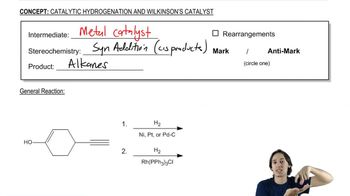
Catalytic Hydrogenation

Catalytic hydrogenation is a chemical reaction that involves the addition of hydrogen (H2) to unsaturated compounds, typically using a metal catalyst like platinum. This process converts alkenes into alkanes, often resulting in the formation of new chiral centers. The stereochemistry of the product can be influenced by the reaction conditions and the nature of the catalyst, making it important to analyze how these factors affect the optical activity of the resulting compound.
Video consigliato:
05:21
General properties of catalytic hydrogenation.
Pratica correlata
Domanda del libro di testo

The original definition of meso is 'an achiral compound that has chiral diastereomers.' Our working definition of meso is 'an achiral compound that has chiral centers (usually asymmetric carbon atoms).' The working definition is much easier to apply, because we don't have to envision all possible chiral diastereomers of the compound. Still, the working definition is not quite as complete as the original definition.

a. Show how cis-cyclooctene is defined as a meso compound under the original definition, but not under our working definition. (Review Figure 5-19)

2027
views
Domanda del libro di testo

3,4-Dimethylpent-1-ene has the formula CH2=CH—CH(CH3)—CH(CH3)2. When pure (R)-3,4-dimethylpent-1-ene is treated with hydrogen over a platinum catalyst, the product is (S)-2,3-dimethylpentane.

a. Draw the equation for this reaction. Show the stereochemistry of the reactant and the product.

b. Has the chiral center retained its configuration during this hydrogenation, or has it been inverted?

3763
views
Domanda del libro di testo

A graduate student was studying enzymatic reductions of cyclohexanones when she encountered some interesting chemistry. When she used an enzyme and NADPH to reduce the following ketone, she was surprised to find that the product was optically active. She carefully repurified the product so that no enzyme, NADPH, or other contaminants were present. Still, the product was optically active.

c. If this reaction could be accomplished using H2 and a nickel catalyst, would the product be optically active? Explain.

1411
views
Domanda del libro di testo

3,4-Dimethylpent-1-ene has the formula CH2=CH—CH(CH3)—CH(CH3)2. When pure (R)-3,4-dimethylpent-1-ene is treated with hydrogen over a platinum catalyst, the product is (S)-2,3-dimethylpentane.

c. The reactant is named (R), but the product is named (S). Does this name change imply a change in the spatial arrangement of the groups around the chiral center? So why does the name switch from (R) to (S)?

2046
views
Domanda del libro di testo

Free-radical bromination of the following compound introduces bromine primarily at the benzylic position next to the aromatic ring. If the reaction stops at the monobromination stage, two stereoisomers result.

d. What is the relationship between the two isomeric products?

e. Will these two products be produced in identical amounts? That is, will the product mixture be exactly 50:50?

f. Will these two stereoisomers have identical physical properties such as boiling point, melting point, solubility, etc.? Could they be separated (theoretically, at least) by distillation or recrystallization?

530
views
Domanda del libro di testo

Draw a three-dimensional structure for each compound, and star all asymmetric carbon atoms. Draw the mirror for each structure, and state whether you have drawn a pair of enantiomers or just the same molecule twice. Build molecular models of any of these examples that seem difficult to you.

(e) chlorocyclohexane

(f) cis-1,2-dichlorocyclobutane

1352
views