

Ch.5 - Stereochemistry
Wade - Organic Chemistry 9th Edition
Wade9th EditionOrganic ChemistryISBN: 9780135213728Non è quello che usi tu?Cambia libro di testo
Capitolo 5, Problema 23

(a) Give the products expected when (+)@glyceraldehyde reacts with HCN. (b) What is the relationship between the products? How might they be separated? (c) Are the products optically active? Explain.

Guida verificata passo dopo passo
1
(a) Identify the functional groups in (+)@glyceraldehyde, which is an aldehyde with a chiral center.
(a) React the aldehyde group with HCN to form a cyanohydrin, adding a CN group to the carbonyl carbon.
(b) Recognize that the reaction creates a new chiral center, resulting in two stereoisomers (diastereomers).
(b) Discuss separation methods such as chromatography or recrystallization, which exploit differences in physical properties.
(c) Evaluate optical activity by considering the presence of chiral centers and the potential for enantiomers.

Risposta video verificata per un problema simile:

Questa soluzione video è stata consigliata dai nostri tutor come utile per risolvere questo problema.
Durata del video:
4m

Concetti chiave

Ecco i concetti essenziali che devi comprendere per rispondere correttamente alla domanda.

Nucleophilic Addition

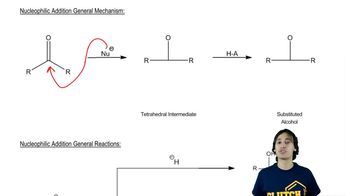
Nucleophilic addition is a fundamental reaction in organic chemistry where a nucleophile attacks an electrophilic carbon atom, leading to the formation of a new bond. In the case of glyceraldehyde reacting with HCN, the cyanide ion (CN-) acts as the nucleophile, attacking the carbonyl carbon of the aldehyde. This reaction results in the formation of a cyanohydrin, which is a key product in this context.
Video consigliato:
08:27
Nucleophilic Addition

Stereochemistry and Isomerism

Stereochemistry refers to the spatial arrangement of atoms in molecules and how this affects their chemical properties. When glyceraldehyde reacts with HCN, the resulting cyanohydrin can exist as two stereoisomers due to the chiral center formed at the carbon that was originally part of the carbonyl group. Understanding the relationship between these isomers, including their potential to be enantiomers, is crucial for discussing their separation and optical activity.
Video consigliato:
Percorso guidato
1:38
Polymer Stereochemistry Concept 1

Optical Activity

Optical activity is the ability of a chiral compound to rotate plane-polarized light, a property that arises from the presence of chiral centers in the molecule. The products of the reaction between glyceraldehyde and HCN are expected to be optically active if they are enantiomers, as each enantiomer will rotate light in opposite directions. This concept is essential for determining the optical properties of the products and their implications in separation techniques.
Video consigliato:
08:17
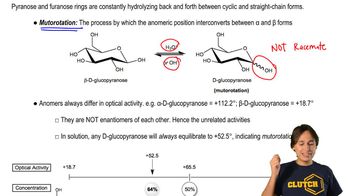
Mutorotation and Optical Activity