Ch.5 - Stereochemistry
Wade - Organic Chemistry 9th Edition
Wade9th EditionOrganic ChemistryISBN: 9780135213728Non è quello che usi tu?Cambia libro di testo
Capitolo 5, Problema 31g,h

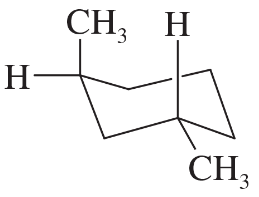
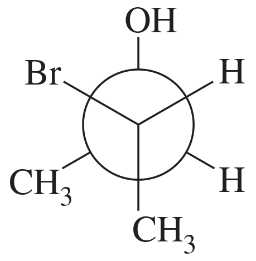
Draw the enantiomer, if any, for each structure.
(g)
(h)

Guida verificata passo dopo passo
1
Step 1: Identify the chiral centers in each structure. A chiral center is a carbon atom bonded to four different groups. In the first structure (g), the chiral centers are the carbons bonded to CH3, H, and the cyclic structure. In the second structure (h), the chiral center is the carbon bonded to OH, Br, CH3, and H.
Step 2: Determine the configuration (R or S) of the chiral centers in the given structures. Assign priorities to the substituents based on the Cahn-Ingold-Prelog rules, and use the clockwise or counterclockwise arrangement to determine the configuration.
Step 3: To draw the enantiomer, invert the configuration of each chiral center. For example, if a chiral center is R in the original structure, it will become S in the enantiomer, and vice versa.
Step 4: Redraw the structure with the inverted configurations. For the cyclic structure (g), flip the wedge and dash bonds at the chiral centers to represent the enantiomer. For the tetrahedral structure (h), swap the positions of the substituents on the chiral center to invert the stereochemistry.
Step 5: Verify that the new structure is a non-superimposable mirror image of the original structure. This confirms that the drawn structure is indeed the enantiomer.

Risposta video verificata per un problema simile:

Questa soluzione video è stata consigliata dai nostri tutor come utile per risolvere questo problema.
Durata del video:
1m

Concetti chiave

Ecco i concetti essenziali che devi comprendere per rispondere correttamente alla domanda.

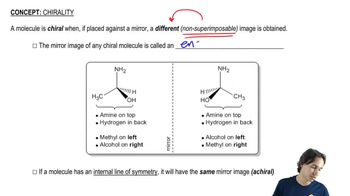
Chirality

Chirality refers to the geometric property of a molecule that makes it non-superimposable on its mirror image. A chiral molecule typically has at least one carbon atom bonded to four different substituents, creating two distinct forms known as enantiomers. These enantiomers can exhibit different chemical behaviors, especially in biological systems.
Video consigliato:
05:10
What is chirality?

Enantiomers

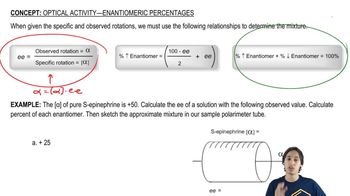
Enantiomers are a pair of chiral molecules that are mirror images of each other. They have identical physical properties, such as melting and boiling points, but can differ significantly in their interactions with polarized light and biological systems. Understanding enantiomers is crucial in organic chemistry, particularly in drug design, where one enantiomer may be therapeutically active while the other is not.
Video consigliato:
03:23
How to solve for the percentage of each enantiomer.

Stereochemistry

Stereochemistry is the study of the spatial arrangement of atoms in molecules and how this affects their chemical behavior. It encompasses concepts such as chirality, enantiomers, and diastereomers. In organic chemistry, stereochemistry is essential for predicting the reactivity and properties of molecules, especially in reactions involving chiral centers.
Video consigliato:
Percorso guidato
1:38
Polymer Stereochemistry Concept 1