
Ch.5 - Stereochemistry
Wade - Organic Chemistry 9th Edition
Wade9th EditionOrganic ChemistryISBN: 9780135213728Non è quello che usi tu?Cambia libro di testo
Capitolo 5, Problema 26a,b

For each structure,
1. star (*) any asymmetric carbon atoms.
2. label each asymmetric carbon as (R) or (S).
3. draw any internal mirror planes of symmetry.
4. label the structure as chiral or achiral.
5. label any meso structures.
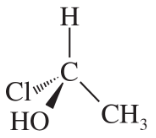
(a)
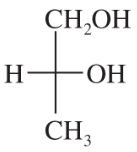
(b)

Guida verificata passo dopo passo
1
Step 1: Identify asymmetric carbon atoms in each structure. An asymmetric carbon is a carbon atom bonded to four different groups. For structure (a), the central carbon is bonded to Cl, OH, CH3, and H, making it asymmetric. For structure (b), the central carbon is bonded to CH2OH, OH, CH3, and H, making it asymmetric.
Step 2: Determine the configuration (R or S) of each asymmetric carbon. Assign priorities to the groups attached to the asymmetric carbon based on the Cahn-Ingold-Prelog rules. For structure (a), assign priorities to Cl (highest), OH, CH3, and H (lowest). For structure (b), assign priorities to CH2OH (highest), OH, CH3, and H (lowest). Use the clockwise or counterclockwise arrangement to determine R or S configuration.
Step 3: Check for internal mirror planes of symmetry. For structure (a), there is no internal mirror plane of symmetry, as the groups attached to the asymmetric carbon are different. For structure (b), check if the molecule has a plane of symmetry dividing it into two identical halves.
Step 4: Label the structure as chiral or achiral. A molecule is chiral if it lacks a plane of symmetry and cannot be superimposed on its mirror image. Structure (a) is chiral because it has an asymmetric carbon and no plane of symmetry. Structure (b) may be achiral if it has a plane of symmetry.
Step 5: Identify meso structures. A meso compound is achiral despite having asymmetric carbons due to an internal plane of symmetry. If structure (b) has a plane of symmetry and is achiral, it can be labeled as a meso compound.

Risposta video verificata per un problema simile:

Questa soluzione video è stata consigliata dai nostri tutor come utile per risolvere questo problema.
Durata del video:
13m

Concetti chiave

Ecco i concetti essenziali che devi comprendere per rispondere correttamente alla domanda.

Asymmetric Carbon Atom

An asymmetric carbon atom, or chiral center, is a carbon atom that is bonded to four different substituents. This unique arrangement allows for the existence of two non-superimposable mirror images, known as enantiomers. Identifying these atoms is crucial for determining the chirality of a molecule.
Video consigliato:
01:44
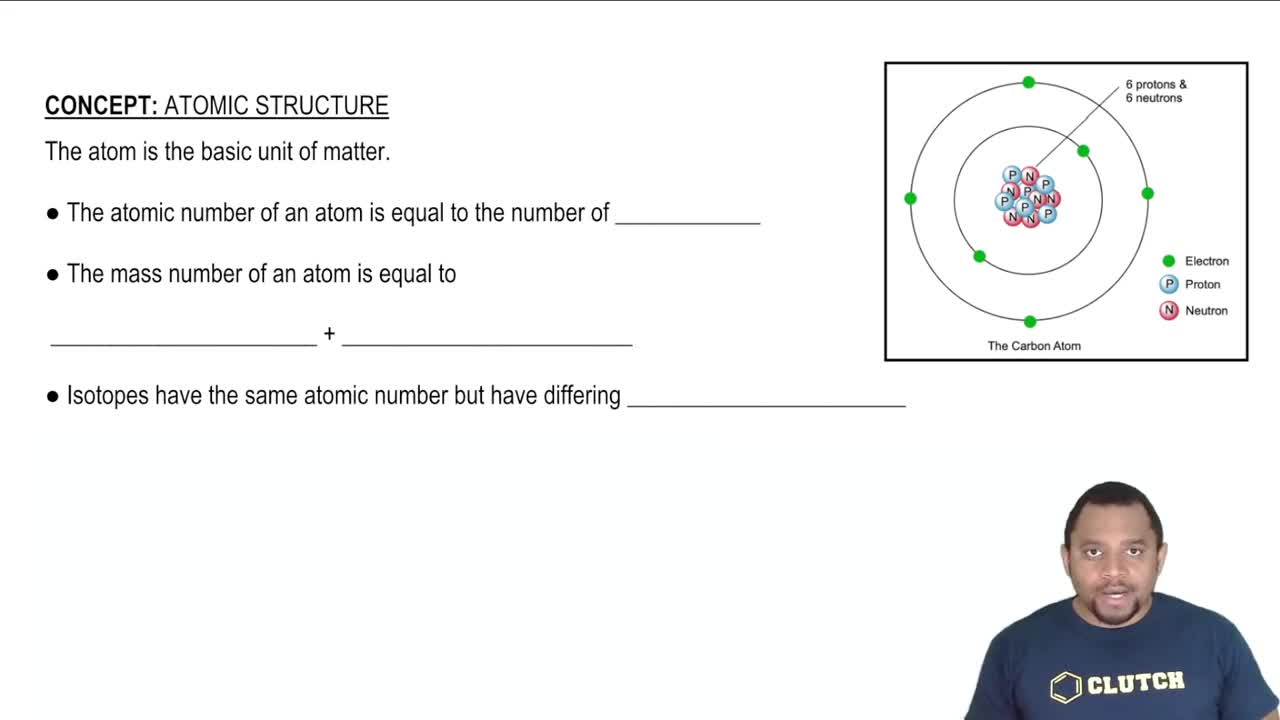
The difference between atomic numbers and atomic mass.

Cahn-Ingold-Prelog Priority Rules

The Cahn-Ingold-Prelog (CIP) priority rules are used to assign the configuration of chiral centers as either (R) or (S). According to these rules, substituents attached to the chiral carbon are ranked based on atomic number, with higher atomic numbers receiving higher priority. The configuration is determined by the arrangement of these substituents in three-dimensional space.
Video consigliato:
01:48
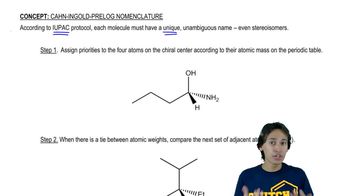
Why stereoisomers need their own naming system.

Chirality and Meso Compounds

Chirality refers to the property of a molecule that is not superimposable on its mirror image, indicating that it has a specific handedness. Meso compounds, however, are a special case where a molecule contains multiple chiral centers but is overall achiral due to an internal plane of symmetry. Recognizing these characteristics is essential for classifying molecules correctly.
Video consigliato:
04:10
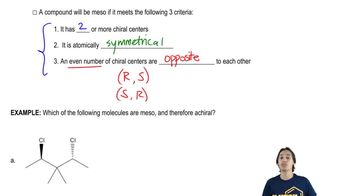
The 3 rules of meso compounds.