Ch. 7 - Structure and Synthesis of Alkenes; Elimination
Wade - Organic Chemistry 9th Edition
Wade9th EditionOrganic ChemistryISBN: 9780135213728Non è quello che usi tu?Cambia libro di testo
Capitolo 7, Problema 42c,d

Determine which compounds show cis-trans isomerism. Draw and label the isomers, using both the cis-trans and E-Z nomenclatures where applicable.
c. hex-3-ene
d. 1,1-dibromopropene

Guida verificata passo dopo passo
1
Step 1: Understand the concept of cis-trans isomerism. Cis-trans isomerism occurs in alkenes where there are two different groups attached to each carbon of the double bond. The 'cis' isomer has the same groups on the same side of the double bond, while the 'trans' isomer has them on opposite sides.
Step 2: Analyze hex-3-ene. Hex-3-ene is an alkene with a double bond between the third and fourth carbon atoms in a six-carbon chain. Check if the groups attached to the double-bonded carbons allow for cis-trans isomerism. Use MathML to represent the structure: C3=C4.
Step 3: Draw and label the isomers for hex-3-ene. If cis-trans isomerism is possible, draw the 'cis' isomer with similar groups on the same side and the 'trans' isomer with similar groups on opposite sides. Use E-Z nomenclature if the groups are different in priority according to Cahn-Ingold-Prelog rules.
Step 4: Analyze 1,1-dibromopropene. This compound has a double bond between the first and second carbon atoms, with two bromine atoms attached to the first carbon. Since both bromine atoms are on the same carbon, cis-trans isomerism is not possible. Use MathML to represent the structure: C1=C2.
Step 5: Conclude which compounds show cis-trans isomerism. Hex-3-ene can exhibit cis-trans isomerism due to the different groups attached to the double-bonded carbons, while 1,1-dibromopropene cannot due to identical groups on one carbon.

Risposta video verificata per un problema simile:

Questa soluzione video è stata consigliata dai nostri tutor come utile per risolvere questo problema.
Durata del video:
5m

Concetti chiave

Ecco i concetti essenziali che devi comprendere per rispondere correttamente alla domanda.

Cis-Trans Isomerism

Cis-trans isomerism, also known as geometric isomerism, occurs in alkenes where two different groups are attached to each carbon of the double bond. In the 'cis' isomer, similar groups are on the same side, while in the 'trans' isomer, they are on opposite sides. This type of isomerism is crucial for understanding the spatial arrangement of molecules and their chemical properties.
Video consigliato:
00:44
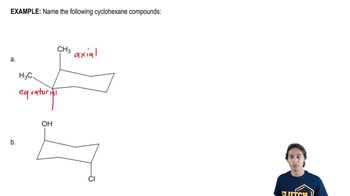
Is the following cyclohexane cis or trans?

E-Z Nomenclature

E-Z nomenclature is a more comprehensive system for describing the stereochemistry of double bonds, especially when more than two different substituents are present. 'E' (from the German 'entgegen') indicates that the higher priority groups are on opposite sides, while 'Z' (from 'zusammen') means they are on the same side. Priority is determined by the Cahn-Ingold-Prelog rules, which consider atomic number and connectivity.
Video consigliato:
03:48
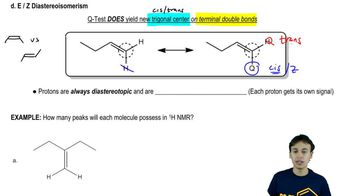
E/Z Diastereoisomerism

Alkene Structure and Substitution

The structure of alkenes, characterized by a carbon-carbon double bond, is pivotal in determining their ability to exhibit isomerism. For cis-trans isomerism to occur, each carbon in the double bond must have two different substituents. In hex-3-ene, the double bond is between the third and fourth carbon, allowing for isomerism, while in 1,1-dibromopropene, the substituents on one carbon are identical, preventing cis-trans isomerism.
Video consigliato:
Percorso guidato
2:09
Alkene Metathesis Concept 1