Ch. 7 - Structure and Synthesis of Alkenes; Elimination
Wade - Organic Chemistry 9th Edition
Wade9th EditionOrganic ChemistryISBN: 9780135213728Non è quello che usi tu?Cambia libro di testo
Capitolo 7, Problema 11a

For each pair of compounds, predict the one with a higher boiling point. Which compounds have zero dipole moments?
a. cis-1,2-dichloroethene or cis-1,2-dibromoethene

Guida verificata passo dopo passo
1
Step 1: Understand that boiling point is influenced by molecular weight and intermolecular forces. Compounds with stronger intermolecular forces or higher molecular weights generally have higher boiling points.
Step 2: Compare the molecular weights of cis-1,2-dichloroethene and cis-1,2-dibromoethene. Bromine is heavier than chlorine, so cis-1,2-dibromoethene has a higher molecular weight.
Step 3: Consider the types of intermolecular forces present. Both compounds have dipole-dipole interactions due to the polar C-Cl and C-Br bonds, but the heavier bromine atoms in cis-1,2-dibromoethene contribute to stronger London dispersion forces.
Step 4: Predict that cis-1,2-dibromoethene will have a higher boiling point due to its higher molecular weight and stronger London dispersion forces.
Step 5: Determine the dipole moment. Both compounds are cis isomers, which means they have a net dipole moment due to the asymmetrical arrangement of the polar bonds. Therefore, neither compound has a zero dipole moment.

Risposta video verificata per un problema simile:

Questa soluzione video è stata consigliata dai nostri tutor come utile per risolvere questo problema.

Concetti chiave

Ecco i concetti essenziali che devi comprendere per rispondere correttamente alla domanda.

Boiling Point and Intermolecular Forces

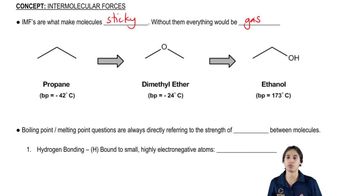
The boiling point of a compound is influenced by the strength of its intermolecular forces. Stronger forces, such as hydrogen bonding, dipole-dipole interactions, and London dispersion forces, result in higher boiling points. In comparing similar compounds, the size and polarizability of the molecules can also affect the boiling point, with larger, more polarizable molecules typically having higher boiling points.
Video consigliato:
03:08
How IMFs are related to melting and boiling points.

Dipole Moment

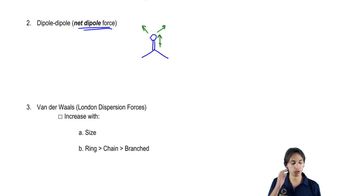
A dipole moment occurs in a molecule when there is an uneven distribution of electron density, resulting in a partial positive and negative charge. Molecules with symmetrical structures, like trans isomers, often have zero dipole moments because the individual bond dipoles cancel each other out. In contrast, asymmetrical molecules, such as cis isomers, usually have a net dipole moment due to the non-cancellation of bond dipoles.
Video consigliato:
01:46
How dipole-dipole forces work.

Cis and Trans Isomerism

Cis and trans isomerism is a type of stereoisomerism where molecules have the same formula but differ in the spatial arrangement of atoms around a double bond. In cis isomers, similar groups are on the same side of the double bond, often resulting in a net dipole moment. Trans isomers have similar groups on opposite sides, which can lead to a cancellation of dipole moments, affecting properties like boiling point and solubility.
Video consigliato:
00:44
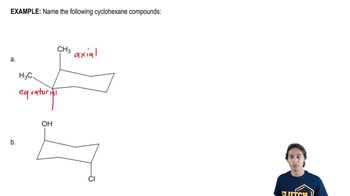
Is the following cyclohexane cis or trans?
Pratica correlata
Domanda del libro di testo

For each pair of compounds, predict the one with a higher boiling point. Which compounds have zero dipole moments?

c. cyclohexene or 1,2-dichlorocyclohexene

1135
views

Domanda del libro di testo

How many stereogenic double bonds are in octa-1,3,5-triene? How many stereocenters are there? Draw and name the four stereoisomers of octa-1,3,5-triene.

1473
views
Domanda del libro di testo

For each pair of compounds, predict the one with a higher boiling point. Which compounds have zero dipole moments?

b. cis- or trans-2,3-dichlorobut-2-ene

1143
views
Domanda del libro di testo

Draw the six stereoisomers of octa-2,4,6-triene. Explain why there are only six stereoisomers, rather than the eight we might expect for a compound with three stereogenic double bonds.

2228
views
Domanda del libro di testo

Teflon-coated frying pans routinely endure temperatures that would cause polyethylene or polypropylene to oxidize and decompose. Decomposition of polyethylene is initiated by free-radical abstraction of a hydrogen atom by O2. Bond-dissociation energies of C—H bonds are about 400 kJ/mol, and C—F bonds are about 460 kJ/mol. The BDE of the H—OO bond is about 192 kJ/mol, and the F—OO bond is about 63 kJ/mol. Show why Teflon (Figure 7-5) is much more resistant to oxidation than polyethylene is.

1208
views
Domanda del libro di testo

Use the data in Table 7-2 to predict the energy difference between 2,3-dimethylbut-1-ene and 2,3-dimethylbut-2-ene. Which of these double-bond isomers is more stable?

907
views