

Ch. 7 - Structure and Synthesis of Alkenes; Elimination
Wade - Organic Chemistry 9th Edition
Wade9th EditionOrganic ChemistryISBN: 9780135213728Non è quello che usi tu?Cambia libro di testo
Capitolo 7, Problema 7-25b

For each reaction, decide whether substitution or elimination (or both) is possible, and predict the products you expect. Label the major products.
b. 1-bromo-1-methylcyclohexane + triethylamine(Et3N:)

Guida verificata passo dopo passo
1
Step 1: Analyze the structure of the substrate, 1-bromo-1-methylcyclohexane. The molecule contains a bromine atom attached to a tertiary carbon (the carbon bonded to three other carbons). This is important because tertiary carbons favor elimination reactions due to steric hindrance, which makes substitution less likely.
Step 2: Consider the nature of the reagent, triethylamine (Et3N:). Triethylamine is a bulky, non-nucleophilic base. Bulky bases typically favor elimination reactions (E2 mechanism) over substitution reactions because their steric bulk prevents them from effectively attacking the carbon atom directly.
Step 3: Determine the mechanism likely to occur. Given the tertiary carbon and the bulky base, the reaction is most likely to proceed via an E2 elimination mechanism. In an E2 reaction, the base abstracts a proton from a β-carbon (a carbon adjacent to the carbon bonded to the leaving group), and the leaving group (bromine) departs simultaneously, forming a double bond.
Step 4: Identify the β-hydrogens available for elimination. In 1-bromo-1-methylcyclohexane, there are β-hydrogens on the carbons adjacent to the tertiary carbon. The elimination can occur in such a way that the most stable alkene is formed, following Zaitsev's rule, which states that the more substituted alkene is the major product.
Step 5: Predict the major product. The elimination of HBr will result in the formation of a double bond in the cyclohexane ring. The major product will be the more substituted alkene, which is 1-methylcyclohexene. Label this as the major product, and note that substitution is unlikely due to the steric hindrance and the nature of the base.

Risposta video verificata per un problema simile:

Questa soluzione video è stata consigliata dai nostri tutor come utile per risolvere questo problema.
Durata del video:
2m

Concetti chiave

Ecco i concetti essenziali che devi comprendere per rispondere correttamente alla domanda.

Nucleophilic Substitution

Nucleophilic substitution is a fundamental reaction in organic chemistry where a nucleophile replaces a leaving group in a molecule. This process can occur via two main mechanisms: SN1 and SN2. The choice between these mechanisms depends on factors such as the structure of the substrate and the strength of the nucleophile. In the given reaction, triethylamine acts as a nucleophile, potentially leading to substitution.
Video consigliato:
01:47
Nucleophiles and Electrophiles can react in Substitution Reactions.

Elimination Reactions

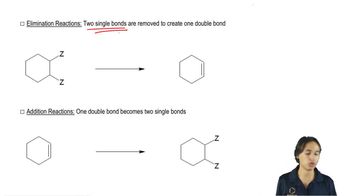
Elimination reactions involve the removal of a small molecule from a larger one, resulting in the formation of a double bond. The two primary types are E1 and E2 mechanisms. E1 reactions are unimolecular and typically occur in two steps, while E2 reactions are bimolecular and occur in a single concerted step. In the context of the provided reaction, elimination may also be possible due to the presence of a strong base like triethylamine.
Video consigliato:
00:40
Recognizing Elimination Reactions.

Regioselectivity and Stereochemistry

Regioselectivity refers to the preference of a chemical reaction to yield one structural isomer over others, while stereochemistry deals with the spatial arrangement of atoms in molecules. In substitution and elimination reactions, the orientation of the product can be influenced by the structure of the starting material and the reaction conditions. Understanding these concepts is crucial for predicting the major products in the reaction of 1-bromo-1-methylcyclohexane with triethylamine.
Video consigliato:
Percorso guidato
1:38
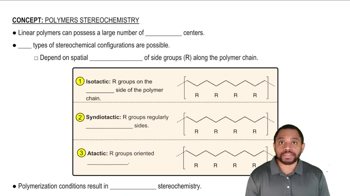
Polymer Stereochemistry Concept 1
Pratica correlata
Domanda del libro di testo

The following names are all incorrect. Draw the structure represented by the incorrect name (or a consistent structure if the name is ambiguous), and give your drawing the correct name.

e. 2,5-dimethylcyclohexene

1083
views
1
rank
Domanda del libro di testo

1. Determine which of the following compounds show cis-trans isomerism.

2. Draw and name the cis and trans (or Z and E) isomers of those that do.

c. hexa-2,4-diene

d. 3-methylpent-2-ene

1075
views
Domanda del libro di testo

The following names are all incorrect. Draw the structure represented by the incorrect name (or a consistent structure if the name is ambiguous), and give your drawing the correct name.

a. cis-dimethylpent-2-ene

b. 3-vinylhex-4-ene

1168
views
Domanda del libro di testo

Some of the following examples can show geometric isomerism, and some cannot. For the ones that can, draw all the geometric isomers, and assign complete names using the E-Z system.

a. 3-bromo-2-chloropent-2-ene

b. 3-ethylhexa-2,4-diene

1472
views
Domanda del libro di testo

1. Determine which of the following compounds show cis-trans isomerism.

2. Draw and name the cis and trans (or Z and E) isomers of those that do.

e. 2,3-dimethylpent-2-ene

f. 3,4-dibromocyclopentene

1434
views
Domanda del libro di testo

The following names are all incorrect. Draw the structure represented by the incorrect name (or a consistent structure if the name is ambiguous), and give your drawing the correct name.

c. 2-methylcyclopentene

d. 6-chlorocyclohexadiene

1267
views