Ch. 7 - Structure and Synthesis of Alkenes; Elimination
Wade - Organic Chemistry 9th Edition
Wade9th EditionOrganic ChemistryISBN: 9780135213728Non è quello che usi tu?Cambia libro di testo
Capitolo 7, Problema 24a

Predict the elimination products of the following reactions. When two alkenes are possible, predict which one will be the major product. Explain your answers, showing the degree of substitution of each double bond in the products.
a. 2-bromopentane + NaOCH3
b. 3-bromo-3-methylpentane + NaOMe (Me = methyl,CH3)
c. 2-bromo-3-ethylpentane + NaOH

Guida verificata passo dopo passo
1
Step 1: Understand the reaction type. These reactions involve elimination (E2 mechanism) because a strong base (NaOCH3 or NaOH) is used. The E2 mechanism proceeds via a single-step process where the base abstracts a proton from a β-carbon, and the leaving group (Br) departs simultaneously, forming a double bond.
Step 2: Identify the β-hydrogens. For each substrate, locate the β-carbons (carbons adjacent to the carbon bonded to the bromine atom) and determine the number of hydrogens available for elimination. This will help identify possible alkenes.
Step 3: Predict the products. For each reaction, consider the possible alkenes formed by elimination of β-hydrogens. Use Zaitsev's rule, which states that the more substituted alkene (the one with more alkyl groups attached to the double bond) is usually the major product due to its greater stability.
Step 4: Analyze substitution patterns. For each product, evaluate the degree of substitution of the double bond. A double bond is considered more substituted if it has more alkyl groups attached to the sp² carbons. Compare the substitution of the possible alkenes to predict the major product.
Step 5: Consider steric hindrance. In cases where steric hindrance affects the reaction (e.g., bulky bases or substrates), the less substituted alkene may be favored. For each reaction, assess whether steric factors could influence the product distribution.

Risposta video verificata per un problema simile:

Questa soluzione video è stata consigliata dai nostri tutor come utile per risolvere questo problema.
Durata del video:
9m

Concetti chiave

Ecco i concetti essenziali che devi comprendere per rispondere correttamente alla domanda.

Elimination Reactions

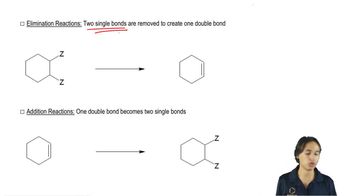
Elimination reactions involve the removal of a leaving group and a hydrogen atom from adjacent carbon atoms, resulting in the formation of a double bond. In organic chemistry, these reactions can follow either an E1 or E2 mechanism, with E2 being a concerted process that requires strong bases. Understanding the mechanism is crucial for predicting the products formed during the reaction.
Video consigliato:
00:40
Recognizing Elimination Reactions.

Zaitsev's Rule

Zaitsev's Rule states that in elimination reactions, the more substituted alkene is typically the major product. This is because more substituted alkenes are generally more stable due to hyperconjugation and the inductive effect. Recognizing the degree of substitution in the products helps in predicting which alkene will be favored in the reaction.
Video consigliato:
01:18
Defining Zaitsev’s Rule

Degree of Substitution

The degree of substitution refers to the number of alkyl groups attached to the carbon atoms involved in the double bond of an alkene. Alkenes can be classified as monosubstituted, disubstituted, trisubstituted, or tetrasubstituted based on the number of substituents. This classification is important for determining the stability of the alkene and predicting the major product in elimination reactions.
Video consigliato:
01:47
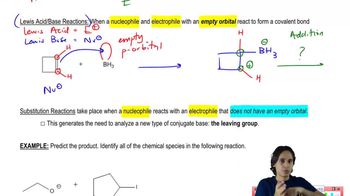
Nucleophiles and Electrophiles can react in Substitution Reactions.
Pratica correlata
Domanda del libro di testo

For each reaction, decide whether substitution or elimination (or both) is possible, and predict the products you expect. Label the major products.

a. 1−bromo−1−methylcyclohexane + NaOH in acetone

2263
views

Domanda del libro di testo

When (1-bromoethyl)cyclohexane is heated in methanol for an extended period of time, five products result: two ethers and three alkenes. Predict which of the three alkenes is the major elimination product.

1157
views
Domanda del libro di testo

Which of these reactions are likely to produce both elimination and substitution products?

a. 2-bromopentane + NaOCH3

b. 3-bromo-3-methylpentane + NaOMe. (Me = methyl, CH3)

c. 2-bromo-3-ethylpentane + NaOH

1326
views
Domanda del libro di testo

For each reaction, decide whether substitution or elimination (or both) is possible, and predict the products you expect. Label the major products.

c. chlorocyclohexane+NaOCH3 in CH3OH

d. chlorocyclohexane + NaOC(CH3)3 in (CH3)3COH

902
views
Domanda del libro di testo

When (1-bromoethyl)cyclohexane is heated in methanol for an extended period of time, five products result: two ethers and three alkenes. Predict the products of this reaction, and propose mechanisms for their formation.

2800
views
Domanda del libro di testo

Under second-order conditions (strong base/nucleophile), SN2 and E2 reactions may occur simultaneously and compete with each other. Show what products might be expected from the reaction of 2-bromo-3-methylbutane (a moderately hindered 2° alkyl halide) with sodium ethoxide.

2147
views
1
comments