


Ch. 7 - Structure and Synthesis of Alkenes; Elimination
Wade - Organic Chemistry 9th Edition
Wade9th EditionOrganic ChemistryISBN: 9780135213728Non è quello che usi tu?Cambia libro di testo
Capitolo 7, Problema 38a

Propose mechanisms for the following reactions. Additional products may be formed, but your mechanism only needs to explain the products shown.
(a)
(Hint: Hydride shift)

Guida verificata passo dopo passo
1
Identify the type of reaction: This reaction involves the conversion of an alcohol (CH3-CH2-CH2-CH2-OH) to an alkene (CH2=CH-CH2CH3). This suggests an elimination reaction, likely an E1 mechanism due to the involvement of a hydride shift.
Step 1: Protonation of the alcohol group: The hydroxyl group (-OH) is a poor leaving group. In the presence of an acid, the -OH group is protonated to form water (H2O), which is a much better leaving group. This step forms a protonated alcohol intermediate.
Step 2: Loss of the leaving group: The protonated alcohol loses water (H2O), forming a carbocation intermediate. The initial carbocation formed is a primary carbocation (CH3-CH2-CH2-CH2+), which is unstable.
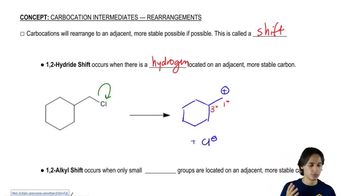
Step 3: Hydride shift: To stabilize the carbocation, a hydride shift occurs. A hydrogen atom (with its bonding electrons) from the adjacent carbon migrates to the carbocation center. This results in the formation of a more stable secondary carbocation (CH3-CH2-CH+-CH3).
Step 4: Formation of the alkene: A base (likely the conjugate base of the acid used in Step 1) abstracts a proton from a β-carbon (a carbon adjacent to the carbocation). This leads to the formation of a double bond, resulting in the final product, CH2=CH-CH2CH3.

Risposta video verificata per un problema simile:

Questa soluzione video è stata consigliata dai nostri tutor come utile per risolvere questo problema.
Durata del video:
5m

Concetti chiave

Ecco i concetti essenziali che devi comprendere per rispondere correttamente alla domanda.

Reaction Mechanisms

A reaction mechanism is a step-by-step description of how reactants transform into products during a chemical reaction. It outlines the sequence of elementary steps, including bond breaking and formation, and provides insight into the intermediates formed. Understanding mechanisms is crucial for predicting the outcome of reactions and for proposing accurate pathways for transformations.
Video consigliato:
02:16
Heck Reaction Mechanism

Hydride Shift

A hydride shift is a type of rearrangement reaction where a hydride ion (H-) moves from one carbon atom to an adjacent carbon atom. This process often occurs in carbocation intermediates to stabilize them by forming a more stable carbocation. Recognizing when a hydride shift can occur is essential for predicting the products of reactions involving carbocations.
Video consigliato:
03:34
Hydride Shift

Alkene Formation

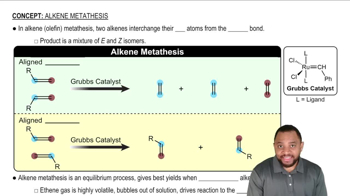
Alkene formation typically involves the elimination of a leaving group and the formation of a double bond between carbon atoms. In the context of the given reaction, understanding how alkenes are generated from alcohols through dehydration or rearrangement is vital. This knowledge helps in predicting the structure of the alkene product formed from the initial alcohol substrate.
Video consigliato:
Percorso guidato
2:09
Alkene Metathesis Concept 1
Pratica correlata
Domanda del libro di testo

For practice in recognizing mechanisms, classify each reaction according to the type of mechanism you expect:

1. Free-radical chain reaction

2. Reaction involving strong bases and strong nucleophiles

3. Reaction involving strong acids and strong electrophiles

(b)

1518
views
Domanda del libro di testo

For practice in recognizing mechanisms, classify each reaction according to the type of mechanism you expect:

1. Free-radical chain reaction

2. Reaction involving strong bases and strong nucleophiles

3. Reaction involving strong acids and strong electrophiles

(c)

1526
views
Domanda del libro di testo

Propose mechanisms for the following reactions.

(a)

HINT: Alcohol dehydrations usually go through E1 elimination of the protonated alcohol, with a carbocation intermediate. Rearrangements are common.

1972
views
Domanda del libro di testo

Propose mechanisms for the following reactions.

(b) 

HINT: Alcohol dehydrations usually go through E1 elimination of the protonated alcohol, with a carbocation intermediate. Rearrangements are common.

961
views
Domanda del libro di testo

For practice in recognizing mechanisms, classify each reaction according to the type of mechanism you expect:

1. Free-radical chain reaction

2. Reaction involving strong bases and strong nucleophiles

3. Reaction involving strong acids and strong electrophiles.

(d)

1435
views
Domanda del libro di testo

Propose mechanisms for the following reactions. Additional products may be formed, but your mechanism only needs to explain the products shown.

(c)

1526
views