
Ch. 7 - Structure and Synthesis of Alkenes; Elimination
Wade - Organic Chemistry 9th Edition
Wade9th EditionOrganic ChemistryISBN: 9780135213728Non è quello che usi tu?Cambia libro di testo
Capitolo 7, Problema 47

The energy difference between cis- and trans-but-2-ene is about 4 kJ/mol; however, the trans isomer of 4,4-dimethylpent-2-ene is nearly 16 kJ/mol more stable than the cis isomer. Explain this large difference.

Guida verificata passo dopo passo
1
Understand the stability difference between cis- and trans-isomers: Cis-isomers generally have higher steric strain due to the proximity of substituents on the same side of the double bond, while trans-isomers are more stable because substituents are on opposite sides, reducing steric interactions.
Analyze the substituents in 4,4-dimethylpent-2-ene: The molecule has bulky methyl groups at the 4th position. In the cis-isomer, these bulky groups are on the same side of the double bond, leading to significant steric hindrance.
Compare steric hindrance in cis- and trans-isomers: In the trans-isomer of 4,4-dimethylpent-2-ene, the bulky methyl groups are positioned on opposite sides of the double bond, minimizing steric interactions and increasing stability.
Relate the energy difference to steric strain: The large energy difference (16 kJ/mol) between the cis- and trans-isomers of 4,4-dimethylpent-2-ene is due to the severe steric strain in the cis-isomer caused by the bulky methyl groups being forced into close proximity.
Conclude the explanation: The greater stability of the trans-isomer is attributed to reduced steric hindrance, which is more pronounced in molecules with bulky substituents like 4,4-dimethylpent-2-ene compared to simpler molecules like but-2-ene.

Risposta video verificata per un problema simile:

Questa soluzione video è stata consigliata dai nostri tutor come utile per risolvere questo problema.
Durata del video:
5m

Concetti chiave

Ecco i concetti essenziali che devi comprendere per rispondere correttamente alla domanda.

Steric Strain

Steric strain occurs when atoms are forced closer together than their natural distance, leading to increased energy and instability. In the case of cis-but-2-ene, the bulky groups are on the same side, causing greater steric hindrance compared to the trans isomer, where the groups are opposite each other, reducing strain.
Video consigliato:
02:00
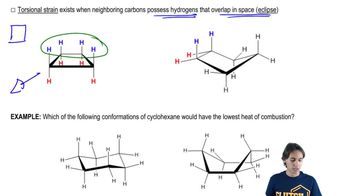
What is torsional strain?

Hyperconjugation

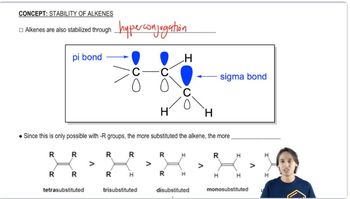
Hyperconjugation is the stabilizing interaction that occurs when the electrons in a sigma bond interact with an adjacent empty or partially filled p-orbital or antibonding orbital. In trans-4,4-dimethylpent-2-ene, the arrangement allows for more effective hyperconjugation, enhancing stability compared to the cis isomer.
Video consigliato:
04:28
Understanding trends of alkene stability.

Substituent Effects

The stability of alkenes is influenced by the nature and position of substituents. In trans-4,4-dimethylpent-2-ene, the presence of two bulky methyl groups on opposite sides minimizes steric interactions, leading to a more stable configuration than in the cis isomer, where these groups are closer together.
Video consigliato:
Percorso guidato
2:02
Directing Effects in Substituted Pyrroles, Furans, and Thiophenes Concept 1