Ch. 7 - Structure and Synthesis of Alkenes; Elimination
Wade - Organic Chemistry 9th Edition
Wade9th EditionOrganic ChemistryISBN: 9780135213728Non è quello che usi tu?Cambia libro di testo
Capitolo 7, Problema 51a,b,c

What halides would undergo E2 dehydrohalogenation to give the following pure alkenes?
a. hex-1-ene
b. isobutylene
c. pent-2-ene

Guida verificata passo dopo passo
1
Step 1: Understand the E2 elimination mechanism. E2 dehydrohalogenation involves the removal of a hydrogen atom (β-hydrogen) and a halide ion (X⁻) from adjacent carbon atoms in a single concerted step, forming a double bond (alkene). The reaction requires a strong base and a good leaving group (halide).
Step 2: Analyze the structure of the desired alkene (product) and determine the position of the double bond. For each case, identify the β-hydrogen and the halide that must be removed to form the double bond in the product.
Step 3: For hex-1-ene, the double bond is between the first and second carbon atoms. The halide must be attached to the first carbon, and a β-hydrogen must be present on the second carbon. Suitable halides include 1-bromohexane, 1-chlorohexane, or 1-iodohexane.
Step 4: For isobutylene, the double bond is between the second and third carbon atoms in a branched structure. The halide must be attached to the second carbon, and a β-hydrogen must be present on the third carbon. Suitable halides include 2-bromoisobutane, 2-chloroisobutane, or 2-iodoisobutane.
Step 5: For pent-2-ene, the double bond is between the second and third carbon atoms. The halide must be attached to either the second or third carbon, and a β-hydrogen must be present on the adjacent carbon. Suitable halides include 2-bromopentane, 2-chloropentane, or 2-iodopentane.

Risposta video verificata per un problema simile:

Questa soluzione video è stata consigliata dai nostri tutor come utile per risolvere questo problema.
Durata del video:
12m

Concetti chiave

Ecco i concetti essenziali che devi comprendere per rispondere correttamente alla domanda.

E2 Mechanism

The E2 mechanism is a type of elimination reaction where a base removes a proton from a β-carbon while a leaving group (such as a halide) departs from the α-carbon simultaneously. This concerted process results in the formation of a double bond. Understanding the stereochemistry and the requirement for anti-periplanar geometry is crucial for predicting the outcome of E2 reactions.
Video consigliato:
09:36
Drawing the E2 Mechanism.

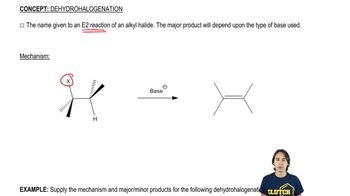
Dehydrohalogenation

Dehydrohalogenation refers to the elimination of a hydrogen halide (HX) from an alkyl halide, leading to the formation of an alkene. This reaction typically requires a strong base and is a key step in synthesizing alkenes from alkyl halides. The choice of base and the structure of the halide influence the reaction pathway and the stability of the resulting alkene.
Video consigliato:
03:02
The dehydrohalogenation mechanism.

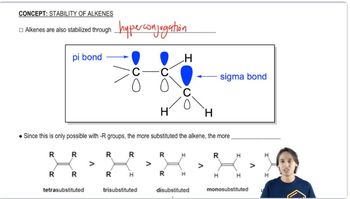
Alkene Stability and Substitution

The stability of alkenes is influenced by their degree of substitution; more substituted alkenes are generally more stable due to hyperconjugation and the inductive effect. This concept is important when predicting which halides will undergo E2 reactions to yield specific alkenes, as the formation of more stable alkenes is favored. Understanding Zaitsev's rule helps in determining the major product in elimination reactions.
Video consigliato:
04:28
Understanding trends of alkene stability.