Ch.8 - Reactions of Alkenes
Wade - Organic Chemistry 9th Edition
Wade9th EditionOrganic ChemistryISBN: 9780135213728Non è quello che usi tu?Cambia libro di testo
Capitolo 8, Problema 71

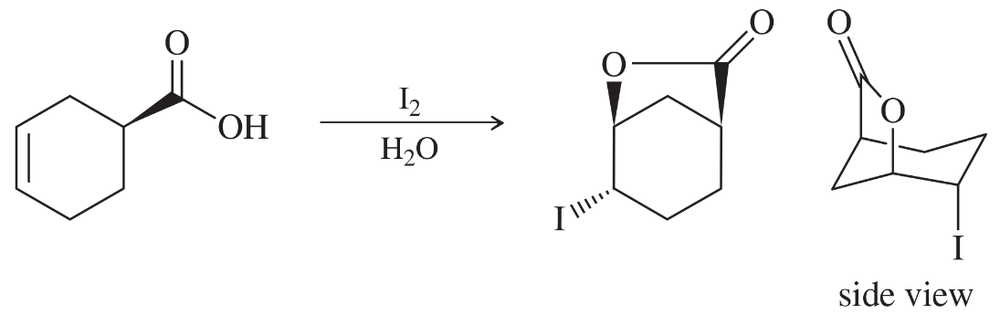
A graduate student attempted to form the iodohydrin of the alkene shown below. Her analysis of the products showed a good yield of an unexpected product. Propose a mechanism to explain the formation of this product.

Guida verificata passo dopo passo
1
Step 1: Analyze the starting material and reaction conditions. The starting material is a cyclic enone with an alcohol group. The reaction conditions involve iodine (I₂) and water (H₂O), which typically facilitate halohydrin formation or electrophilic addition reactions.
Step 2: Consider the electrophilic addition mechanism. Iodine (I₂) can act as an electrophile, reacting with the alkene in the enone to form a cyclic iodonium ion intermediate. This intermediate is highly reactive and can undergo nucleophilic attack.
Step 3: Examine the role of water as a nucleophile. Water can attack the cyclic iodonium ion, leading to the formation of a halohydrin. However, the observed product suggests an alternative pathway involving intramolecular interactions.
Step 4: Propose an intramolecular nucleophilic attack mechanism. The hydroxyl group (-OH) on the starting material can act as a nucleophile, attacking the cyclic iodonium ion. This intramolecular attack leads to the formation of a bicyclic structure with an iodine atom and an ester functional group.
Step 5: Rationalize the stereochemistry of the product. The side view of the product indicates that the iodine atom and the ester group are positioned in a specific stereochemical arrangement. This stereochemistry arises from the constraints of the cyclic structure and the intramolecular attack mechanism.

Risposta video verificata per un problema simile:

Questa soluzione video è stata consigliata dai nostri tutor come utile per risolvere questo problema.
Durata del video:
3m

Concetti chiave

Ecco i concetti essenziali che devi comprendere per rispondere correttamente alla domanda.

Iodohydrin Formation

Iodohydrin formation involves the addition of iodine (I2) and water (H2O) across a double bond in an alkene. This reaction typically proceeds through the formation of a cyclic halonium ion intermediate, which is then attacked by water, leading to the formation of an iodohydrin. Understanding this mechanism is crucial for predicting the products formed in the reaction.
Video consigliato:
02:26
Formation of Enolates

Mechanism of Electrophilic Addition

The mechanism of electrophilic addition describes how alkenes react with electrophiles, such as iodine, to form more stable products. The double bond acts as a nucleophile, attacking the electrophile and forming a carbocation or a cyclic intermediate. This concept is essential for understanding how the unexpected product may arise from the reaction conditions or the structure of the alkene.
Video consigliato:
05:39
Features of Addition Mechanisms.

Stereochemistry of Products

Stereochemistry refers to the spatial arrangement of atoms in molecules and how this affects their chemical behavior. In the case of iodohydrin formation, the stereochemistry of the product can lead to different isomers, including enantiomers or diastereomers. Analyzing the stereochemical outcomes is important for explaining the unexpected product observed in the student's analysis.
Video consigliato:
Percorso guidato
1:38
Polymer Stereochemistry Concept 1
Pratica correlata
Domanda del libro di testo

Propose a mechanism for reaction of the first three propylene units in the polymerization of propylene in the presence of a peroxide.

1694
views

Domanda del libro di testo

When styrene (vinylbenzene) is commercially polymerized, about 1–3% of 1,4-divinylbenzene is often added to the styrene. The incorporation of some divinylbenzene gives a polymer with more strength and better resistance to organic solvents. Explain how a very small amount of divinylbenzene has a marked effect on the properties of the polymer.

1427
views
Domanda del libro di testo

An unknown compound decolorizes bromine in carbon tetrachloride, and it undergoes catalytic reduction to give decalin. When treated with warm, concentrated potassium permanganate, this compound gives cis-cyclohexane-1,2-dicarboxylic acid and oxalic acid. Propose a structure for the unknown compound.

1089
views
Domanda del libro di testo

The cationic polymerization of isobutylene (2-methylpropene) is shown in Section 8-16A. Isobutylene is often polymerized under free-radical conditions. Propose a mechanism for the free-radical polymerization of isobutylene.

1342
views
Domanda del libro di testo

The following cyclization has been observed in the oxymercuration-demercuration of this unsaturated alcohol. Propose a mechanism for this reaction.

1641
views
1
rank
Domanda del libro di testo

Predict the product of formula C7H13BrO from the reaction of this same unsaturated alcohol with bromine. Propose a mechanism to support your prediction.

1582
views