Ch.8 - Reactions of Alkenes
Wade - Organic Chemistry 9th Edition
Wade9th EditionOrganic ChemistryISBN: 9780135213728Non è quello che usi tu?Cambia libro di testo
Capitolo 8, Problema 27b

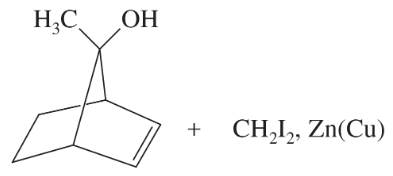
Predict the carbenoid addition products of the following reactions.
(b)

Guida verificata passo dopo passo
1
Step 1: Recognize the reaction type. The given reaction involves CH2I2 and Zn(Cu), which is a Simmons-Smith reaction. This reaction is used to form cyclopropane rings by adding a carbenoid (CH2) group to alkenes.
Step 2: Identify the alkene in the substrate. In the provided structure, the double bond is located in the cyclopentene ring. This is the site where the carbenoid addition will occur.
Step 3: Understand the mechanism. The Zn(Cu) reacts with CH2I2 to generate the carbenoid species (ICH2ZnI), which is highly reactive and adds to the double bond of the alkene in a concerted manner, forming a cyclopropane ring.
Step 4: Predict the product. The double bond in the cyclopentene ring will be replaced by a cyclopropane ring, preserving the stereochemistry of the original molecule. The hydroxyl group (-OH) and methyl group (-CH3) attached to the bicyclic structure remain unchanged.
Step 5: Verify stereochemistry. The Simmons-Smith reaction typically preserves the stereochemistry of the alkene, so the relative configuration of substituents around the newly formed cyclopropane ring will match the original stereochemistry of the alkene.

Risposta video verificata per un problema simile:

Questa soluzione video è stata consigliata dai nostri tutor come utile per risolvere questo problema.
Durata del video:
5m

Concetti chiave

Ecco i concetti essenziali che devi comprendere per rispondere correttamente alla domanda.

Carbenoids

Carbenoids are reactive intermediates that resemble carbenes but are more stable and can be generated from certain precursors, such as diazomethane or the combination of zinc and alkyl halides. They are used in organic synthesis to facilitate the addition of carbon to double bonds, allowing for the formation of new carbon-carbon bonds.
Video consigliato:
03:13
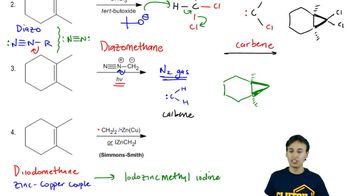
The Simmons-Smith reaction.

Zinc-Copper Couple

The zinc-copper couple is a reagent system commonly used in organic chemistry to generate carbenoids from alkyl halides. When zinc is combined with copper in the presence of an alkyl halide, it facilitates the transfer of an electron, leading to the formation of a carbenoid that can react with alkenes or other nucleophiles.
Video consigliato:
05:05
Sonogashira Coupling Reaction

Stereochemistry of Addition Reactions

Stereochemistry refers to the spatial arrangement of atoms in molecules and is crucial in predicting the outcomes of addition reactions. In the context of carbenoid reactions, the stereochemistry of the starting materials influences the configuration of the addition products, which can lead to different isomers depending on the orientation of the reactants during the reaction.
Video consigliato:
Percorso guidato
1:38
Polymer Stereochemistry Concept 1