Ch.8 - Reactions of Alkenes
Wade - Organic Chemistry 9th Edition
Wade9th EditionOrganic ChemistryISBN: 9780135213728Non è quello che usi tu?Cambia libro di testo
Capitolo 8, Problema 6a

Predict the products of the following hydration reactions.
a. 1−methylcyclopentene + dilute acid

Guida verificata passo dopo passo
1
Step 1: Recognize that the reaction involves the hydration of an alkene using dilute acid. This is an electrophilic addition reaction where water adds across the double bond.
Step 2: Identify the alkene in the structure. The double bond is located within the cyclopentene ring, and the substituent is a methyl group attached to the ring.
Step 3: Understand the mechanism. The dilute acid (H⁺) protonates the double bond, forming a carbocation intermediate. The stability of the carbocation is crucial, and rearrangements may occur to form the most stable carbocation.
Step 4: Predict the regioselectivity of the addition. According to Markovnikov's rule, the hydroxyl group (−OH) will add to the more substituted carbon of the double bond, while the hydrogen (H⁺) will add to the less substituted carbon.
Step 5: Draw the product. The final product will be an alcohol where the −OH group is attached to the more substituted carbon of the original double bond, resulting in 1-methylcyclopentanol.

Risposta video verificata per un problema simile:

Questa soluzione video è stata consigliata dai nostri tutor come utile per risolvere questo problema.
Durata del video:
4m

Concetti chiave

Ecco i concetti essenziali che devi comprendere per rispondere correttamente alla domanda.

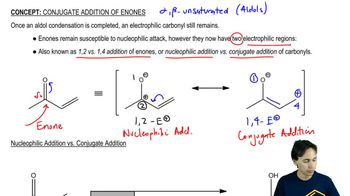
Electrophilic Addition

Electrophilic addition is a fundamental reaction mechanism in organic chemistry where an electrophile reacts with a nucleophile, typically involving alkenes. In the case of hydration reactions, the alkene acts as a nucleophile, attacking an electrophilic species, such as a proton from an acid, leading to the formation of a carbocation intermediate.
Video consigliato:
09:23
1,2 vs 1,4 Addition

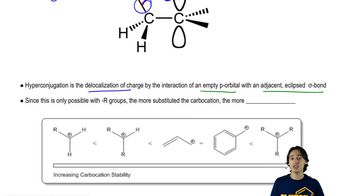
Carbocation Stability

Carbocation stability is crucial in predicting the products of reactions involving alkenes. The stability of a carbocation is influenced by its degree (primary, secondary, tertiary) and the presence of electron-donating groups. More stable carbocations are favored during reactions, guiding the formation of the final product in hydration reactions.
Video consigliato:
05:58
Determining Carbocation Stability

Markovnikov's Rule

Markovnikov's Rule states that in the addition of HX to an alkene, the hydrogen atom will attach to the carbon with the greater number of hydrogen atoms already attached. This principle helps predict the regioselectivity of hydration reactions, indicating that the hydroxyl group will preferentially add to the more substituted carbon of the alkene.
Video consigliato:
03:54
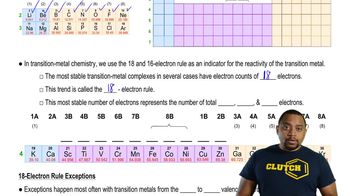
The 18 and 16 Electron Rule