Ch.8 - Reactions of Alkenes
Wade - Organic Chemistry 9th Edition
Wade9th EditionOrganic ChemistryISBN: 9780135213728Non è quello che usi tu?Cambia libro di testo
Capitolo 8, Problema 56g

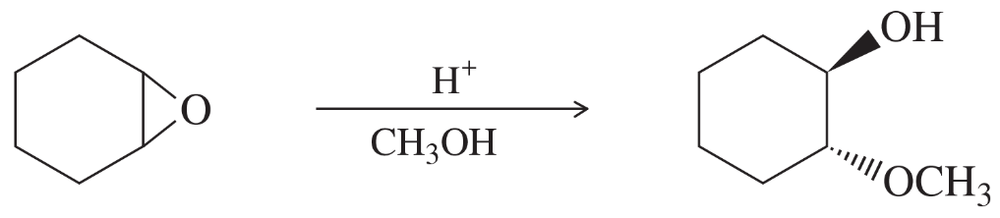
Propose mechanisms consistent with the following reactions.
(g)

Guida verificata passo dopo passo
1
Step 1: Analyze the starting material, which is an epoxide (a three-membered cyclic ether). Epoxides are highly strained and reactive due to the angle strain in the three-membered ring.
Step 2: Recognize the reaction conditions. The presence of H⁺ (acidic conditions) and CH₃OH (methanol) suggests that the epoxide will undergo acid-catalyzed ring opening. Acidic conditions protonate the oxygen atom in the epoxide, making it more electrophilic.
Step 3: Protonation of the epoxide oxygen occurs first. The lone pair on the oxygen atom interacts with H⁺, forming a positively charged oxonium ion. This step increases the electrophilicity of the epoxide and facilitates nucleophilic attack.
Step 4: Methanol (CH₃OH) acts as the nucleophile and attacks one of the carbon atoms in the epoxide ring. The attack occurs at the more substituted carbon atom due to the stability of the resulting carbocation-like transition state. This leads to the opening of the epoxide ring.
Step 5: Deprotonation of the methanol group occurs, resulting in the formation of the final product. The product contains an alcohol (-OH) group and a methoxy (-OCH₃) group on adjacent carbons, with stereochemistry determined by the anti-addition mechanism of the ring opening.

Risposta video verificata per un problema simile:

Questa soluzione video è stata consigliata dai nostri tutor come utile per risolvere questo problema.
Durata del video:
12m

Concetti chiave

Ecco i concetti essenziali che devi comprendere per rispondere correttamente alla domanda.

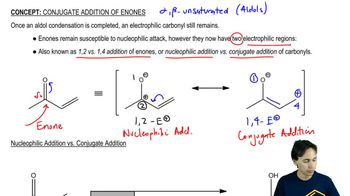
Electrophilic Addition

Electrophilic addition is a fundamental reaction mechanism in organic chemistry where an electrophile reacts with a nucleophile, resulting in the formation of a new bond. In the context of the provided reaction, the carbonyl group (C=O) acts as an electrophile, attracting nucleophiles such as methanol (CH3OH) in the presence of an acid catalyst (H+). This mechanism is crucial for understanding how the reactants transform into the product.
Video consigliato:
09:23
1,2 vs 1,4 Addition

Protonation of Carbonyls

Protonation of carbonyls involves the addition of a proton (H+) to the oxygen atom of a carbonyl group, increasing its electrophilicity. This step is essential in the mechanism as it makes the carbonyl carbon more susceptible to nucleophilic attack. In the reaction shown, the carbonyl oxygen is protonated, facilitating the subsequent attack by methanol and leading to the formation of a hemiacetal.
Video consigliato:
04:20
Carboxylic Acids Nomenclature

Hemiacetal Formation

Hemiacetal formation occurs when an alcohol reacts with an aldehyde or ketone, resulting in a compound that contains both an alcohol (-OH) and an ether (-O-R) functional group. In the reaction depicted, methanol adds to the protonated carbonyl, yielding a hemiacetal. This intermediate is significant in organic synthesis and can further react to form acetals under certain conditions.
Video consigliato:
06:23
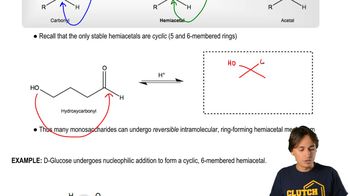
Monosaccharides - Forming Cyclic Hemiacetals
Pratica correlata
Domanda del libro di testo

Propose mechanisms consistent with the following reactions.

(d)

981
views

Domanda del libro di testo

Cyclohexene is dissolved in a solution of lithium chloride in chloroform. To this solution is added one equivalent of bromine. The material isolated from this reaction contains primarily a mixture of trans-1,2-dibromocyclohexane and trans-1-bromo-2-chlorocyclohexane. Propose a mechanism to show how these compounds are formed.

1140
views
Domanda del libro di testo

Propose mechanisms consistent with the following reactions.

(c)

1087
views
Domanda del libro di testo

Propose mechanisms consistent with the following reactions.

(f)

1520
views
Domanda del libro di testo

Draw an approximate reaction-energy diagram showing the curves for the two possible pathways for ionic addition of HBr to 1-methylcyclohexene. (a) Formation of the major product, 1-bromo-1-methylcyclohexane, and (b) formation of the minor product, 1-bromo-2-methylcyclohexane. Point out how these curves show that 1-bromo-1-methylcyclohexane should be formed faster.

2055
views
Domanda del libro di testo

Unknown X, C5H9Br does not react with bromine or with dilute KMnO4. Upon treatment with potassium tert-butoxide, X gives only one product, Y, C5H8. Unlike X, Y decolorizes bromine and changes KMnO4 from purple to brown. Catalytic hydrogenation of Y gives methylcyclobutane. Ozonolysis–reduction of Y gives dialdehyde Z, C5H8O2. Propose consistent structures for X, Y, and Z. Is there any aspect of the structure of X that is still unknown?

908
views