Ch.8 - Reactions of Alkenes
Wade - Organic Chemistry 9th Edition
Wade9th EditionOrganic ChemistryISBN: 9780135213728Non è quello che usi tu?Cambia libro di testo
Capitolo 8, Problema 35d

Show how you would accomplish the following conversions.
d. trans-hex-3-ene to (d,l)-hexane-3,4-diol

Guida verificata passo dopo passo
1
Step 1: Recognize that the conversion involves adding hydroxyl groups (-OH) to the trans-hex-3-ene molecule. This is a dihydroxylation reaction, which typically converts an alkene into a vicinal diol (two hydroxyl groups on adjacent carbons).
Step 2: Select an appropriate reagent for syn-dihydroxylation. Common reagents include osmium tetroxide (OsO₄) with a co-oxidant like N-methylmorpholine N-oxide (NMO) or potassium permanganate (KMnO₄) under mild conditions. These reagents add hydroxyl groups to the double bond in a syn fashion.
Step 3: Consider the stereochemistry of the product. Since the starting material is trans-hex-3-ene, the addition of hydroxyl groups will result in a meso compound or a racemic mixture (d,l) of hexane-3,4-diol, depending on the reaction conditions. Ensure the reaction conditions favor the formation of the desired stereoisomer.
Step 4: Write the mechanism for the reaction. The alkene undergoes coordination with the reagent (e.g., OsO₄), forming a cyclic intermediate. This intermediate is then hydrolyzed to yield the vicinal diol. Use MathML to represent the chemical structures and reaction mechanism.
Step 5: Verify the product structure. The final product, (d,l)-hexane-3,4-diol, should have hydroxyl groups on carbons 3 and 4, with the stereochemistry reflecting the racemic mixture. Confirm that the reaction conditions and reagents used align with the desired outcome.

Risposta video verificata per un problema simile:

Questa soluzione video è stata consigliata dai nostri tutor come utile per risolvere questo problema.
Durata del video:
2m

Concetti chiave

Ecco i concetti essenziali che devi comprendere per rispondere correttamente alla domanda.

Alkenes and Their Reactions

Alkenes are hydrocarbons that contain at least one carbon-carbon double bond. They are reactive compounds that can undergo various reactions, such as hydrogenation, hydrohalogenation, and hydration. Understanding the reactivity of alkenes is crucial for converting trans-hex-3-ene into other functional groups, as these reactions will dictate the pathway to the desired product.
Video consigliato:
Percorso guidato
2:09
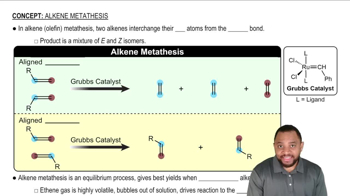
Alkene Metathesis Concept 1

Stereochemistry

Stereochemistry is the study of the spatial arrangement of atoms in molecules and how this affects their chemical behavior. In the conversion of trans-hex-3-ene to (d,l)-hexane-3,4-diol, it is important to consider the stereochemical configuration of the product, as it contains chiral centers. Recognizing the stereochemical implications of reactions helps in predicting the formation of specific isomers.
Video consigliato:
Percorso guidato
1:38
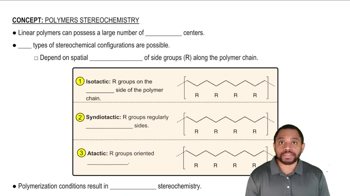
Polymer Stereochemistry Concept 1

Diol Formation

Diols, or glycols, are compounds containing two hydroxyl (-OH) groups. The conversion of alkenes to diols typically involves syn or anti-dihydroxylation reactions, where the addition of hydroxyl groups occurs across the double bond. Understanding the mechanisms of diol formation is essential for successfully synthesizing (d,l)-hexane-3,4-diol from trans-hex-3-ene, as it determines the regioselectivity and stereochemistry of the final product.
Video consigliato:
02:26
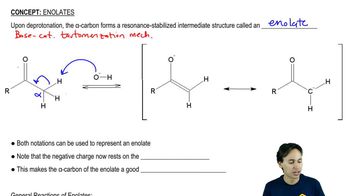
Formation of Enolates