Ch.8 - Reactions of Alkenes
Wade - Organic Chemistry 9th Edition
Wade9th EditionOrganic ChemistryISBN: 9780135213728Non è quello che usi tu?Cambia libro di testo
Capitolo 8, Problema 11c

Show how you would accomplish the following synthetic conversions.
c. 2-bromo-2,4-dimethylpentane → 2,4-dimethylpentan-3-ol

Guida verificata passo dopo passo
1
Identify the functional group transformation: The starting material is 2-bromo-2,4-dimethylpentane (an alkyl halide), and the target compound is 2,4-dimethylpentan-3-ol (an alcohol). This suggests a substitution reaction where the bromine atom is replaced by a hydroxyl group (-OH).
Choose the appropriate reaction mechanism: Since the starting material is a tertiary alkyl halide, the substitution reaction is likely to proceed via an SN1 mechanism. Tertiary alkyl halides favor the SN1 mechanism due to the stability of the carbocation intermediate.
Select the nucleophile and reaction conditions: Use water (H₂O) or a hydroxide ion (OH⁻) as the nucleophile. Water can act as a weak nucleophile in the SN1 reaction, while hydroxide ion can be used under basic conditions to achieve the substitution.
Outline the reaction mechanism: In the SN1 mechanism, the reaction proceeds in two steps: (1) The bromine atom leaves, forming a tertiary carbocation intermediate. (2) The nucleophile (H₂O or OH⁻) attacks the carbocation, resulting in the formation of the alcohol product.
Consider any necessary workup: If water is used as the nucleophile, the intermediate product will be a protonated alcohol. Perform a deprotonation step (e.g., using a base) to yield the neutral alcohol, 2,4-dimethylpentan-3-ol.

Risposta video verificata per un problema simile:

Questa soluzione video è stata consigliata dai nostri tutor come utile per risolvere questo problema.
Durata del video:
4m

Concetti chiave

Ecco i concetti essenziali che devi comprendere per rispondere correttamente alla domanda.

Nucleophilic Substitution

Nucleophilic substitution is a fundamental reaction in organic chemistry where a nucleophile replaces a leaving group in a molecule. In the context of the conversion from 2-bromo-2,4-dimethylpentane to 2,4-dimethylpentan-3-ol, a nucleophile, such as hydroxide ion (OH-), can attack the carbon bonded to the bromine atom, leading to the formation of an alcohol.
Video consigliato:
01:47
Nucleophiles and Electrophiles can react in Substitution Reactions.

Rearrangement Reactions

Rearrangement reactions involve the structural reorganization of a molecule to form a different isomer. In this synthetic conversion, understanding how the carbon skeleton can rearrange during the reaction is crucial, especially if the reaction pathway involves carbocation intermediates that can lead to more stable structures.
Video consigliato:
06:08
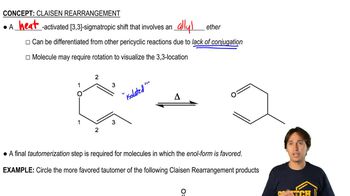
Definition of Claisen Rearrangement

Alcohol Functional Group

The alcohol functional group (-OH) is characterized by the presence of a hydroxyl group attached to a carbon atom. In the target molecule, 2,4-dimethylpentan-3-ol, recognizing the position of the hydroxyl group is essential for understanding the properties and reactivity of the compound, as well as the implications for synthesis and potential reactions it may undergo.
Video consigliato:
02:36
Identifying Functional Groups