Ch.8 - Reactions of Alkenes
Wade - Organic Chemistry 9th Edition
Wade9th EditionOrganic ChemistryISBN: 9780135213728Non è quello che usi tu?Cambia libro di testo
Capitolo 8, Problema 9c

Show how you would accomplish the following synthetic conversions.
c. 3-methylpent-1-ene → 3-methylpentan-2-ol
Explain why acid-catalyzed hydration would be a poor choice for the reaction in (c).

Guida verificata passo dopo passo
1
Step 1: Analyze the starting material and the target product. The starting material is 3-methylpent-1-ene, an alkene, and the target product is 3-methylpentan-2-ol, an alcohol. This indicates that the reaction involves the addition of an -OH group to the alkene, specifically at the second carbon.
Step 2: Recognize that acid-catalyzed hydration of alkenes typically follows Markovnikov's rule, where the -OH group adds to the more substituted carbon. However, in this case, acid-catalyzed hydration would lead to the formation of 3-methylpentan-3-ol (not 3-methylpentan-2-ol) due to carbocation rearrangement. This makes acid-catalyzed hydration a poor choice.
Step 3: To achieve the desired product, use hydroboration-oxidation as the reaction mechanism. This method involves two steps: (1) hydroboration, where BH₃ or a borane derivative adds to the alkene in an anti-Markovnikov fashion, and (2) oxidation, where the boron atom is replaced by an -OH group using hydrogen peroxide (H₂O₂) in a basic medium (NaOH).
Step 4: Write the reaction sequence. In the first step, treat 3-methylpent-1-ene with BH₃·THF (borane in tetrahydrofuran) to form the organoborane intermediate. In the second step, oxidize the intermediate with H₂O₂/NaOH to yield 3-methylpentan-2-ol.
Step 5: Summarize why hydroboration-oxidation is the preferred method. It avoids carbocation rearrangement and ensures anti-Markovnikov addition, leading to the formation of the desired product, 3-methylpentan-2-ol, with high regioselectivity.

Risposta video verificata per un problema simile:

Questa soluzione video è stata consigliata dai nostri tutor come utile per risolvere questo problema.
Durata del video:
2m

Concetti chiave

Ecco i concetti essenziali che devi comprendere per rispondere correttamente alla domanda.

Hydration Reactions

Hydration reactions involve the addition of water to an alkene, resulting in the formation of alcohols. In acid-catalyzed hydration, an acid protonates the alkene, creating a more stable carbocation intermediate that can then react with water. This process is typically regioselective, favoring the formation of the more stable alcohol, but can lead to rearrangements that complicate the desired product formation.
Video consigliato:
09:11
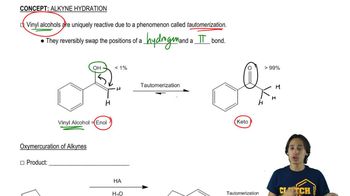
Alkyne Hydration

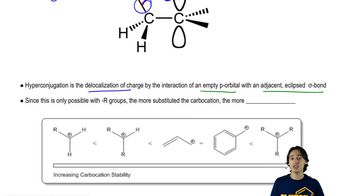
Carbocation Stability

Carbocation stability is crucial in determining the outcome of reactions involving carbocations. Tertiary carbocations are more stable than secondary or primary ones due to hyperconjugation and inductive effects. In the case of 3-methylpent-1-ene, the formation of a secondary carbocation during acid-catalyzed hydration may lead to rearrangements, resulting in undesired products rather than the target 3-methylpentan-2-ol.
Video consigliato:
05:58
Determining Carbocation Stability

Markovnikov's Rule

Markovnikov's Rule states that in the addition of HX to an alkene, the hydrogen atom will attach to the carbon with the greater number of hydrogen atoms, leading to the more stable carbocation. In the context of the conversion from 3-methylpent-1-ene to 3-methylpentan-2-ol, applying this rule could lead to the formation of a different alcohol than intended, making acid-catalyzed hydration a poor choice for achieving the desired product.
Video consigliato:
03:54
The 18 and 16 Electron Rule