Ch.8 - Reactions of Alkenes
Wade - Organic Chemistry 9th Edition
Wade9th EditionOrganic ChemistryISBN: 9780135213728Non è quello che usi tu?Cambia libro di testo
Capitolo 8, Problema 45b

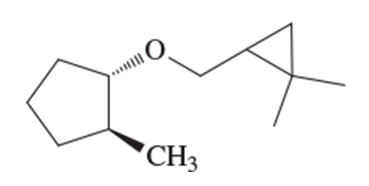
Show how you would synthesize each compound, starting with alkenes or cycloalkenes that contain no more than six carbon atoms. You may use any additional reagents you need.
(b)

Guida verificata passo dopo passo
1
Step 1: Begin with a cyclopentene molecule as the starting alkene. Cyclopentene contains five carbons and satisfies the requirement of using alkenes with no more than six carbons.
Step 2: Perform hydroboration-oxidation on cyclopentene to introduce an alcohol group (-OH) at the less substituted carbon. Use BH₃·THF followed by H₂O₂/NaOH for this reaction.
Step 3: Convert the alcohol group into a good leaving group, such as a tosylate (-OTs), using p-toluenesulfonyl chloride (TsCl) and pyridine. This step prepares the molecule for substitution reactions.
Step 4: Perform an SN2 reaction with a methyl group donor, such as CH₃⁻ (from CH₃I and a strong base like NaH), to replace the tosylate group with a methyl group (-CH₃). This introduces the methyl group at the desired position.
Step 5: Finally, use an alkylation reaction to attach the isopropyl group to the oxygen atom. React the alcohol with an isopropyl halide (e.g., (CH₃)₂CH-Br) in the presence of a base like NaH to form the ether bond.

Risposta video verificata per un problema simile:

Questa soluzione video è stata consigliata dai nostri tutor come utile per risolvere questo problema.
Durata del video:
12m

Concetti chiave

Ecco i concetti essenziali che devi comprendere per rispondere correttamente alla domanda.

Alkenes and Cycloalkenes

Alkenes are hydrocarbons that contain at least one carbon-carbon double bond, while cycloalkenes are cyclic compounds with one or more double bonds. These compounds are fundamental in organic synthesis due to their reactivity, allowing for various reactions such as addition, polymerization, and oxidation. Understanding their structure and reactivity is crucial for designing synthetic pathways.
Video consigliato:
01:11
How to find the root name for cycloalkanes

Reagents in Organic Synthesis

Reagents are substances used in chemical reactions to facilitate the transformation of reactants into products. In organic synthesis, common reagents include acids, bases, oxidizing agents, and reducing agents, each serving specific roles in reactions. Knowledge of how these reagents interact with alkenes and cycloalkenes is essential for successful compound synthesis.
Video consigliato:
Percorso guidato
1:16
Synthesis of Amino Acids: Strecker Synthesis Example 1

Functional Group Transformations

Functional group transformations involve changing one functional group into another, which is a key strategy in organic synthesis. For example, converting alkenes into alcohols or ethers through reactions like hydroboration-oxidation or epoxidation. Recognizing how to manipulate functional groups allows chemists to create complex molecules from simpler starting materials.
Video consigliato:
02:36
Identifying Functional Groups